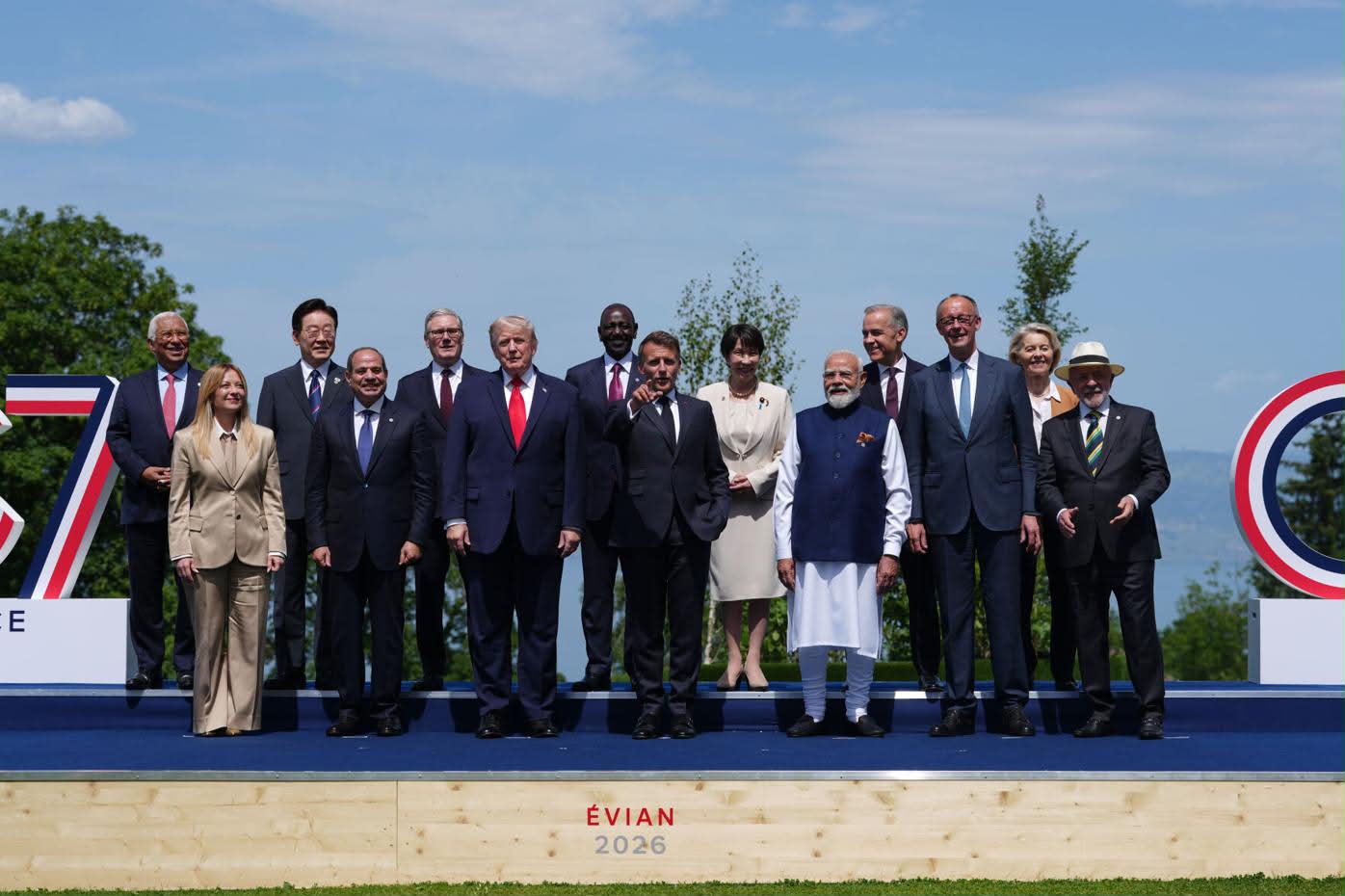
Evian: The most revealing feature of this year’s G7 summit in the French Alps was not any single declaration but the structure of the guest list. France seated Brazil, India, Kenya, South Korea, Egypt, Qatar, Ukraine and the United Arab Emirates alongside the core members, and brought the World Bank, the IMF, the OECD and the African Development Bank into the room. A club built around Western economic dominance spent its two days demonstrating that it can no longer set the global agenda by itself, and that it knows it.
For the European Union, which sits at the table as an institution rather than a state, the summit was an exercise in managing dependence without admitting fragility. The leaders issued statements on geopolitical risk, on tackling migrant smuggling, on drug trafficking and on what they called mutually beneficial international partnerships. The language of partnership, repeated across documents, is itself a tell. It signals a turn away from the assumption that emerging economies will simply align with Western preferences, and toward the harder work of bargaining for their cooperation.
Beneath the communiques lies an uncomfortable reality the Europeans rarely state aloud. The transatlantic relationship, long the load-bearing wall of the G7, has become a source of uncertainty rather than reassurance. Trade frictions, divergent security priorities and unpredictable signals from Washington have pushed European capitals to treat their most important ally as a variable to be insured against. The flurry of outreach to middle powers, on display at Evian and in parallel deals such as the recent partnership with South Korea, is best understood as a diversification strategy dressed in the vocabulary of solidarity.
That diversification carries its own contradictions. The declaration on mutually beneficial partnerships courts countries whose strategic interests only partly overlap with Europe’s, and whose leverage grows precisely as the West’s relative weight declines. Inviting Brazil and India to the table acknowledges their importance, but it does not deliver their agreement on tariffs, technology controls or the war in Ukraine. Convening is the easy part. Converting presence into commitment is where summits usually disappoint.
The statement on migrant smuggling is a case study in the gap between ambition and instrument. European governments face acute domestic pressure on migration, and a coordinated G7 line against smuggling networks offers a useful signal of resolve. Yet smuggling routes are driven by demand, conflict and economic desperation that no leaders’ declaration can switch off. The risk is that the document becomes a substitute for the slower, costlier cooperation with origin and transit states that would actually move the numbers.
What Evian did achieve was atmospheric rather than transactional, and that should not be dismissed. In a period when multilateral forums are routinely written off as theatre, the willingness of the major democracies to coordinate with a wider circle of partners has value as a habit, a set of relationships kept warm against future need. The call for a coordinated response to the Bundibugyo Ebola outbreak showed the format still functioning where interests genuinely align and the cost of cooperation is low.
For Brussels the lesson is double-edged. The summit confirmed that the EU retains a seat at the centre of global economic governance, but it also exposed how much of that centrality now rests on alliances it must actively cultivate rather than inherit. The age in which the G7 could assume the rest of the world would follow is over. The Evian guest list was an acknowledgment of that shift, and the partnerships language was an attempt to make a virtue of it. Whether Europe can turn this widened table into durable leverage, rather than a longer list of relationships to manage, is the question the communiques carefully left unanswered.