Brussels: As Europe enters another summer braced for wildfires and floods, the Union is quietly rebuilding the way it prepares for disaster, expanding its shared reserves of emergency equipment even as the global pool of humanitarian money shrinks around it. The contrast defines the moment. On one side, the EU is pre-positioning aircraft and stockpiles for crises on its own territory. On the other, it has set an initial humanitarian aid budget of 1.9 billion euro for 2026 at a time when 239 million people worldwide need assistance and major donors are cutting back. Europe is investing in resilience at home while the international relief system it helps fund comes under strain.
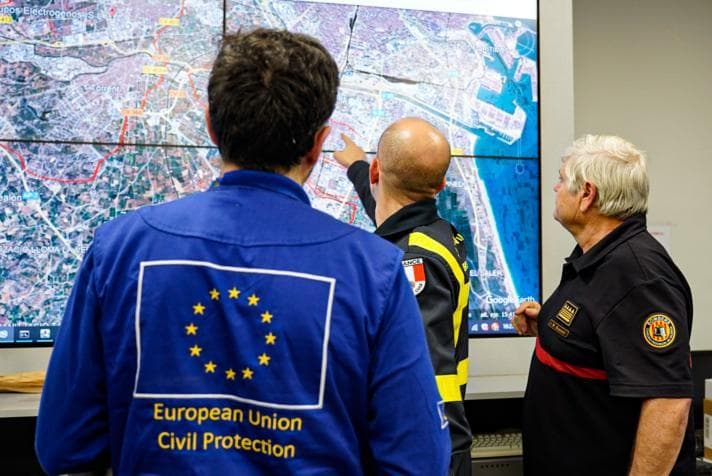
The clearest expression of the domestic push is rescEU, the strategic reserve of response capabilities financed directly by the Union rather than left to individual member states. For the 2026 season the Commission has backed the acquisition of 12 new firefighting planes to be based in Portugal, Spain, France, Italy, Croatia and Greece, alongside three helicopters stationed in Slovakia, Czechia and Romania. The first helicopter of the new fleet was delivered to Romania in January and is already declared ready for the wildfire season. Parliament added a further 10 million euro to the Civil Protection Mechanism and rescEU in the 2026 budget, an acknowledgement that the frequency and intensity of natural disasters have outrun the old model of national self-reliance.
The logic behind pooling is sound and worth stating plainly. A wildfire in southern Europe rarely coincides with one in the north, so aircraft pre-positioned across the continent can be moved to wherever the season turns severe. Shared assets spread a cost no single government would rationally carry alone for capacity it might need only in its worst years. In effect, rescEU functions as mutual insurance against climate-driven emergencies, and the steady enlargement of its fleet suggests member states increasingly accept that framing.
The external picture is harder. The 1.9 billion euro headline for 2026 is distributed across the globe’s crisis map: 557 million euro for Sub-Saharan Africa, 463 million for the Middle East and North Africa, 294 million for Asia, Latin America, the Pacific and the Caribbean, 153 million for Ukraine, the Western Balkans and the Caucasus, and 415 million in non-geographical allocations. Parliament secured a 35 million euro increase in response to mounting instability and climate-induced emergencies. Yet against needs measured in the hundreds of millions of people, and against retrenchment by other large donors, the sum stretches thin. The EU’s relative weight in global humanitarian funding rises not because its own contribution has surged but because others are stepping back.
That shift carries a strategic cost the budget lines do not capture. As traditional donors withdraw, the EU is left more exposed, both financially and reputationally, in theatres where humanitarian access is already entangled with security and diplomacy. Doing more by default, rather than by deliberate choice, is a weak foundation for sustained engagement, and it raises the prospect of difficult triage as fixed money is spread across widening needs.
A fair assessment resists easy praise or alarm. The internal investment in rescEU is a genuine advance, turning ad hoc cross-border assistance into a standing, EU-funded capability that will save lives and property in coming summers. The external commitment, while substantial in absolute terms, is being asked to do more with proportionally less as the wider system contracts. The two trends are not contradictory so much as revealing. Europe is choosing, consciously, to harden its own disaster response, while its capacity to shape relief beyond its borders depends on choices made in capitals it does not control.
The wildfire fleet now stationed from Romania to Portugal is the visible, reassuring face of that strategy. The quieter story sits in the humanitarian ledger, where a rising share of a shrinking global effort is a poor substitute for a system in which the burden was more widely shared.