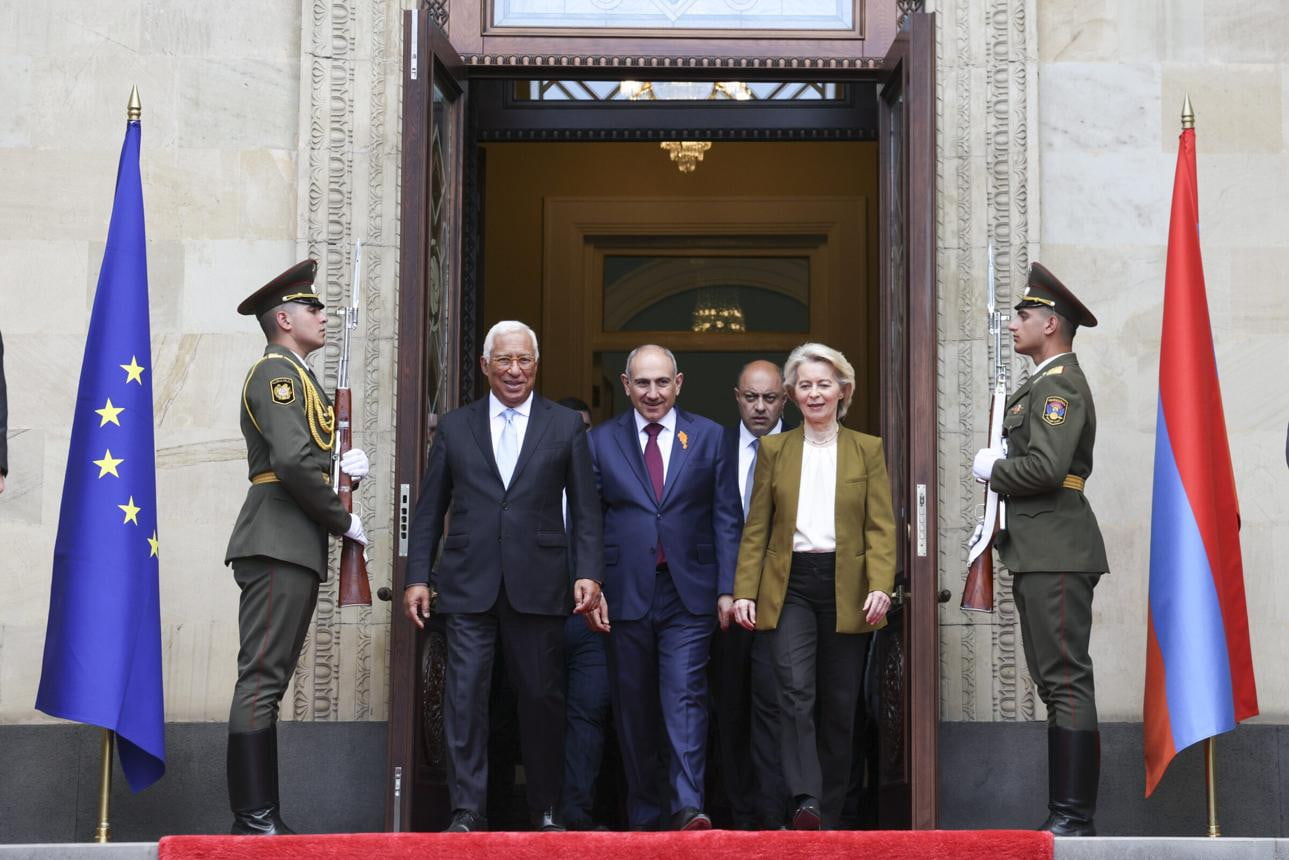
Yerevan: When Armenian and European leaders put their names to a Connectivity Partnership in the Armenian capital this spring, they did more than fill a line on a crowded diplomatic calendar. They confirmed that a small, landlocked republic long treated as Moscow’s junior partner now measures its future by how far it can travel west.
The first-ever EU-Armenia summit drew Council President Antonio Costa and Commission President Ursula von der Leyen to a country that, only a few years ago, leaned on Russian troops and Kremlin security guarantees. Prime Minister Nikol Pashinyan has spent the intervening period loosening those ties, and the May meeting handed the drift an institutional frame.
The substance sits below the ceremony. Brussels and Yerevan agreed to structure high-level dialogues on transport, energy and digital links, and the Commission opened a twelve-month call inviting European and Armenian firms to pitch investments in energy, semiconductors, healthcare and manufacturing. A 270 million euro Resilience and Growth Plan underwrites the effort, modest by the standards of enlargement but pointed enough to signal intent.
Armenia reads the arithmetic clearly. The European Union already buys the largest share of its exports and channels the most investment, and the Comprehensive and Enhanced Partnership Agreement in force since 2021 gives both sides a legal scaffold most neighbours lack. What changed in Yerevan is the political willingness to build on it in public, with the Kremlin watching.
The risks are real. Armenia still hosts Russian energy infrastructure, its border with Azerbaijan remains unsettled despite a fragile peace track, and Moscow retains levers over gas, remittances and the diaspora economy. Europe, for its part, has offered a partnership rather than a membership path, and the gap between the two can breed disappointment in a population that wants a firmer anchor.
Yet the direction of travel favours Brussels. By tying Armenia into the same connectivity logic it is spreading across the South Caucasus and Central Asia, the Union turns a bilateral gesture into a corridor strategy that reaches the Caspian and beyond. The partnership documents speak the language of infrastructure, but the subtext is geopolitics.
The test now falls on delivery. Letters of intent and expressions of interest are cheap; roads, grids and fibre are not. If European money moves at the speed of European summitry, Yerevan’s westward bet will look premature. If it moves faster, Armenia becomes the clearest proof yet that the EU can pull a former Russian client into its orbit without firing a shot or promising a flag.