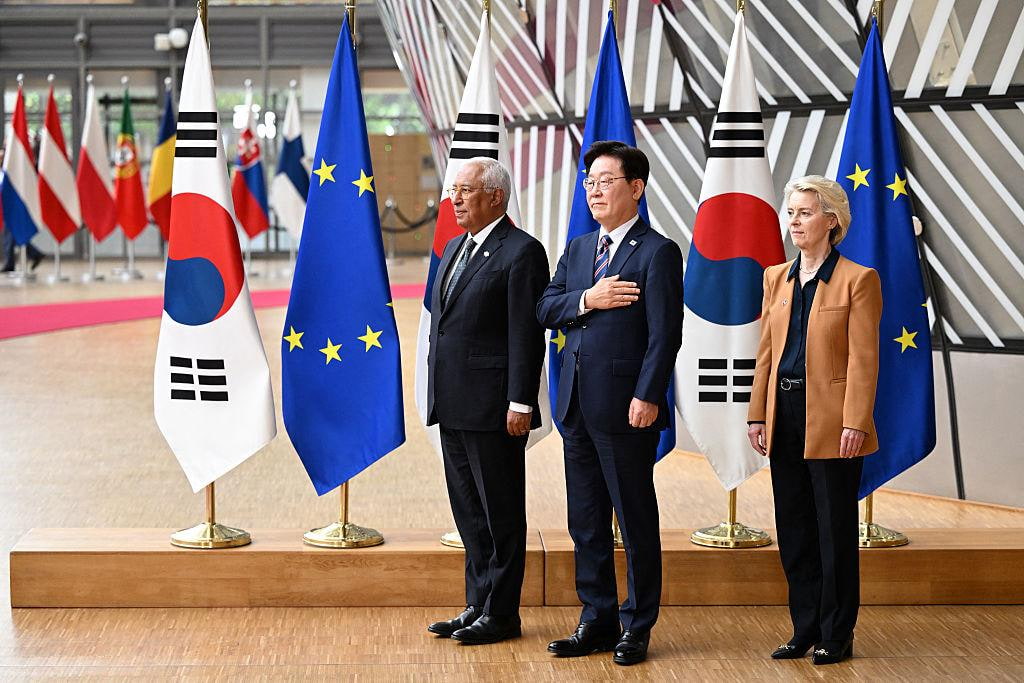
Songdo: The most consequential document Europe signed with an Asian partner this year contains almost no tariffs. When the European Union and South Korea concluded their Digital Trade Agreement at their June summit in Brussels, they were not haggling over goods at a border. They were writing law for the invisible economy that already moves between them every second.
The numbers explain the urgency. South Korea now ranks as the EU’s eighth-largest trading partner, with goods trade topping €124 billion in 2025. Yet the fastest-growing slice of that relationship never touches a port. Roughly a third of the services the two economies exchange arrive as data, and Brussels calculates that digitally delivered trade alone is worth around €11 billion a year.
The new agreement builds a rulebook around those flows. It guarantees that data can cross between the two markets without arbitrary blocking, and it bars governments from demanding a company’s source code as the price of market access. It recognises electronic contracts and electronic signatures, and it sets shared standards for protecting consumers who shop across the digital divide.
What makes the deal unusual is the discipline it imposes on both sides at once. Europe has spent a decade insisting that free data movement must never dilute privacy, and Seoul has matched that instinct. Only weeks after the summit, South Korea passed the EU’s periodic review of its data-adequacy status, confirming that Korean firms can keep handling European personal data under Europe’s own standards. That mutual trust, rather than any tariff line, is the real asset the agreement protects.
The strategic logic is hard to miss. Both economies sit next to a far larger neighbour that treats data as a lever of state power and increasingly walls off its digital market. By agreeing that information should flow on rules rather than on political whim, Brussels and Seoul are quietly building an alternative model for how open economies can trade in bits without surrendering control of them.
The Brussels summit paired the digital pact with a new competitiveness partnership and a dialogue on supply-chain resilience, signalling that the two governments see openness and security as parts of the same project rather than rivals.
Implementation will decide whether the ambition survives contact with reality. Ratification in the European Parliament and the Korean National Assembly could stretch into next year, and the clauses on data flows will only matter if regulators on both sides resist the temptation to carve out exceptions the moment a politically sensitive sector complains.
Still, the direction is set. Europe has found, in a mid-sized democracy eight thousand kilometres away, a partner willing to write the same rules it believes in. In an era when digital borders are hardening almost everywhere else, that quiet convergence may prove more durable than any headline trade figure.