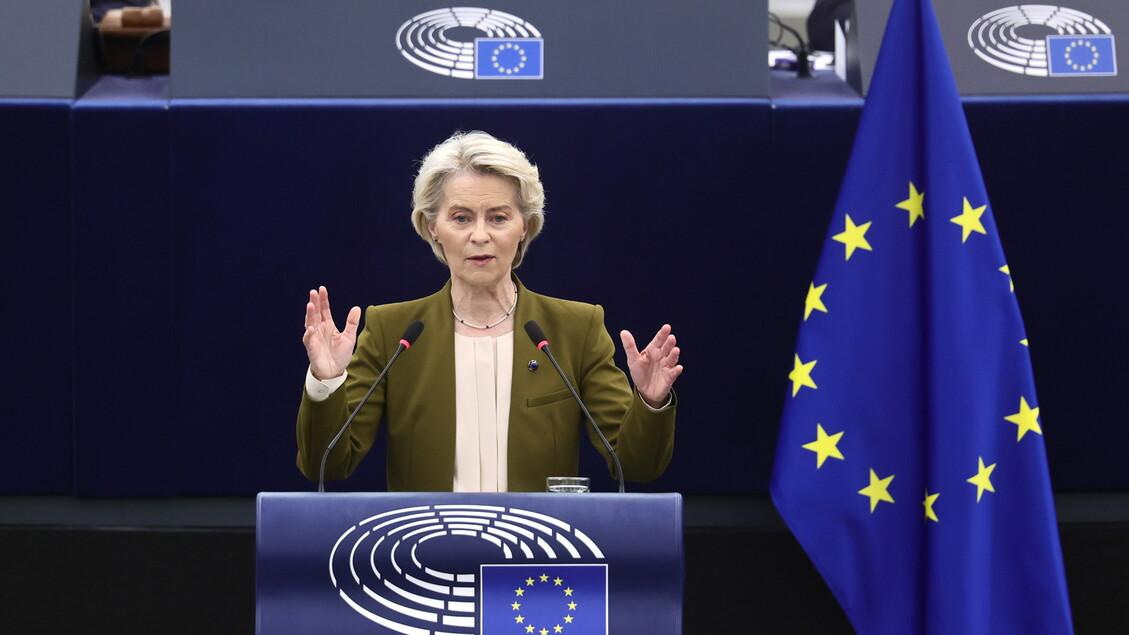
The European Security Council proposed in this week’s State of the Union is the most institutionally ambitious idea Ursula von der Leyen has floated on defence, and also the least defined. Announced in Strasbourg on 16 September 2026, it would sit alongside a second new mechanism, an Emergency Security Protocol modelled on NATO’s Article 4. Neither proposal carries a date, a budget line or a treaty base.
## What the European Security Council would actually do
As described from the hemicycle, the European Security Council would convene the Union together with partners outside it – Canada, Norway, Ukraine and the United Kingdom were named – and calibrate responses to threats according to their nature and scale. The Commission said only that it “will set out our ideas” to make the body real.
That phrasing matters. A leaders’ format that includes non-members cannot be created by ordinary legislation, and the European Council already exists as the Union’s strategic apex. The proposal therefore reads less as a new institution than as a standing invitation to a coalition the EU cannot formally command.
## Why an EU version of Article 4 is the harder sell
The companion idea is a consultation clause for incidents falling below armed aggression. Triggered by a single member state, it would oblige all others to convene, coordinate a European response and, in the Commission president’s words, deter further escalation.
The difficulty is not the design but the demand. NATO’s Article 4 has no damage threshold and can be invoked at will, yet allies have not invoked it after recent flank incidents, including a shootdown over Lithuania. Capitals that decline to call a meeting they are already entitled to call are unlikely to be moved by a second venue in a different building.
### The clause Brussels already has
The speech did not mention Article 42.7 of the Treaty on European Union, the existing mutual-assistance clause. That omission is conspicuous: an April summit in Nicosia tasked the Commission and the High Representative’s service with drafting an operational blueprint for 42.7, hybrid cases included. No blueprint has been published. A new protocol now lands on the same overloaded desk.
## The enablers instrument is the item with numbers behind it
The third announcement drew less applause and deserves more. A European Instrument for Strategic Enablers would cover air and missile defence, strategic transport, air-to-air refuelling, space and cyber – precisely the capabilities Europe rents from the United States.
This one maps onto a measurable gap rather than a procedural one. Recent American force-model reductions stripped tankers from the European pool, and air-to-air refuelling sits explicitly on the Commission’s list. An instrument of that kind needs a legal base and a line in the next multiannual financial framework; a consultation protocol needs only a speech.
## Key takeaways
– The European Security Council would include Canada, Norway, Ukraine and the UK, none of them EU members.
– The Emergency Security Protocol duplicates a NATO clause that goes unused rather than unavailable.
– Article 42.7, the treaty’s own mutual-assistance provision, went unmentioned despite an outstanding mandate to operationalise it.
– The Strategic Enablers instrument is the only proposal tied to a quantified capability shortfall.
## What happens next
A new European security strategy is due jointly from the Commission and High Representative Kaja Kallas, and the security protocol appears inside it as an example rather than a standalone proposal. Sequencing will be the real signal. Kallas withdrew a high-level defence advisory group on 7 September, a day before its launch, after Paris and Berlin withheld support – a reminder that member states guard defence architecture closely.
If the enablers instrument reaches the college as a legislative text before the European Security Council acquires a legal form, Wednesday’s speech will be remembered as a procurement decision dressed as constitutional ambition. If neither arrives by year’s end, it will be remembered as neither.