Seven competing resolutions went into Thursday’s vote and one came out. By 339 votes to 225, with 16 abstentions, the European Parliament adopted a text on the arrivals at Ceuta that describes what happened as an instrumentalisation of irregular migration and a tool of hybrid warfare. The number that matters is not the majority. It is the seven. The groups that normally assemble a working centrist majority spent days trying to agree a joint text and failed, which is why the plenary was handed a choice between rival drafts rather than a negotiated one.
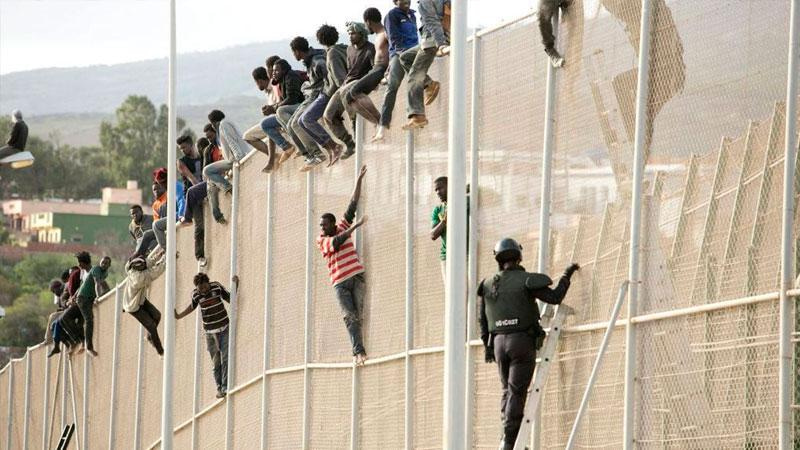
The event behind the vote is not in dispute. On 30 July, roughly 80,000 people attempted to enter the Spanish enclave. Several thousand remained in a city of some 85,000 residents, among them unaccompanied minors, and the reception capacity of a territory that size was exhausted within hours. What is in dispute is everything that follows from that: whether the arrivals were organised or permitted, by whom, and what the Union owes a member state whose external border is also a land border with a partner country.
The adopted resolution answers those questions in one direction. It asks Morocco to respect the territorial integrity of member states and frames that as a non-negotiable condition of its partnership with the Union, language that reaches well beyond migration management and into the long-standing question of sovereignty over the enclaves. It calls for the swift and effective return of everyone without a right to remain, explicitly including unaccompanied minors, while adding that returns must comply with EU and international law. Those two clauses sit awkwardly together. The protections owed to unaccompanied children under both bodies of law are procedural and individualised, and no return of minors that satisfies them will be swift.
The resolution also turns inward, attributing part of the pull toward Ceuta to the Spanish government’s regularisation policy. That is where the left’s objections concentrated. Attributing a border surge to a domestic measure taken by one national government converts a resolution about external pressure into a verdict on a member state’s internal politics, and it is the reason a joint text proved impossible. Rabat, for its part, sent messages to members ahead of the vote denying any intention to provoke a crisis and promising to readmit those who crossed. Moroccan commentary since has rejected the hybrid-warfare characterisation as unevidenced.
Read alongside a separate vote in which members backed, by 435 to 209, an amendment to a report on hybrid threats condemning the attack on the Union’s southern border, a pattern is visible. The Parliament is converging on instrumentalisation as the analytical frame for migration pressure at every external border, having developed the concept for the eastern frontier and now applying it to the southern one. The frame carries consequences. Once arrivals are classified as an attack rather than a movement of people, the instruments that follow are the ones designed for coercion, and the humanitarian obligations that apply to each individual become the exception argued against the rule rather than the starting point.
None of this binds the Commission. A resolution is an opinion, and the operative decisions on the Morocco partnership, on funding, on how the new returns framework is applied, belong elsewhere. What the vote does establish is that the majority which normally carries migration files in this Parliament no longer holds on the hardest cases, and that a text needing votes from the right can now be adopted over the objections of parts of the centre. That is a durable fact about this legislature, and it will be tested again well before the Ceuta caseload is resolved.