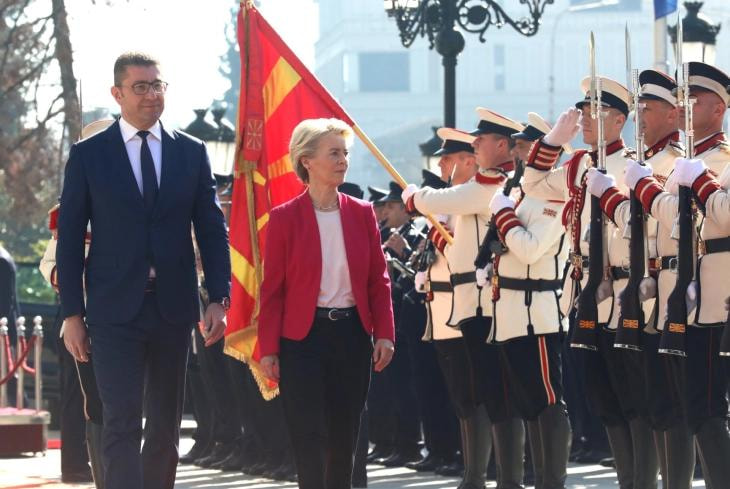
Skopje: The itinerary is the message. When the European Commission President sets out on 30 September for her sixth consecutive autumn tour of the Western Balkans, two of the region’s capitals will not be on it. Belgrade and Sarajevo have been dropped from a trip that will now run through Tirana, Pristina, Podgorica and Skopje, and the official reason given is that Bosnia and Herzegovina votes on 4 October and Serbia on 25 October. Brussels, a spokesperson explained, does not wish to have a role in either contest.
The formula of non-interference is reasonable enough on its face. It is also the first time in six years that the calculation has produced this answer, and the difference is worth examining rather than accepting.
The annual tour began in autumn 2021, at a moment when accession had stalled and the Commission was searching for something to offer a region that had stopped believing in timetables. It was, from the start, a political instrument as much as a diplomatic one. The President’s presence in a capital signalled that the file had not been abandoned. That is precisely why her absence now signals something too, and why the Balkans in Europe Policy Advisory Group wrote to her in September arguing that a visit to Belgrade during the campaign’s final phase risked being read as an endorsement of the incumbent authorities. Serbia has spent nearly two years in a societal crisis that began with the collapse of the Novi Sad station canopy on 1 November 2024, in which sixteen people died, and which has sustained a student-led protest movement ever since. In a media environment that polarised, a photograph is an argument.
The Bosnian omission follows the same reasoning with less of the controversy attached to it. General elections there will determine the tripartite Presidency alongside the national, entity and cantonal assemblies, and there is no version of a presidential visit three days beforehand that reads as neutral.
What the four remaining stops will hear is, in one sense, more consequential than anything the two skipped capitals would have. The Commission is expected to announce how it redistributes roughly 330 million euro under the Growth Plan for the Western Balkans, and the arithmetic is not symmetrical. Albania, Montenegro and North Macedonia are positioned to gain. Serbia and Kosovo are expected to lose a portion of their allocations for failing to deliver agreed reforms during the first payment period. Bosnia and Herzegovina has until the end of December before its own grace period lapses.
That is the Growth Plan working as designed. Money conditioned on reform is meant to move, and a mechanism that never redistributes anything is not a mechanism. But it produces an awkward coincidence. Kosovo will be visited and will lose funds. Serbia will not be visited and will lose funds. The capital that receives the President is not necessarily the capital receiving good news, and the two tracks of European policy in the region, the political and the financial, are running on different logics this autumn.
The tour also begins on the same day the Commission publishes its long-delayed pre-enlargement policy reviews, a communication that has slipped by close to a year and that is expected to sketch a new generation of accession treaties, including safeguards against backsliding once a country is inside. For Montenegro and Albania, the two candidates closest to the finish, the content of that paper matters more than any bilateral meeting. It defines the terms of the thing they are negotiating to join.
Enlargement has always been a process in which the Union changes the applicant. The reviews arriving on 30 September concern how much the applicant is permitted to change the Union. That question will outlast every election on this autumn’s calendar.