
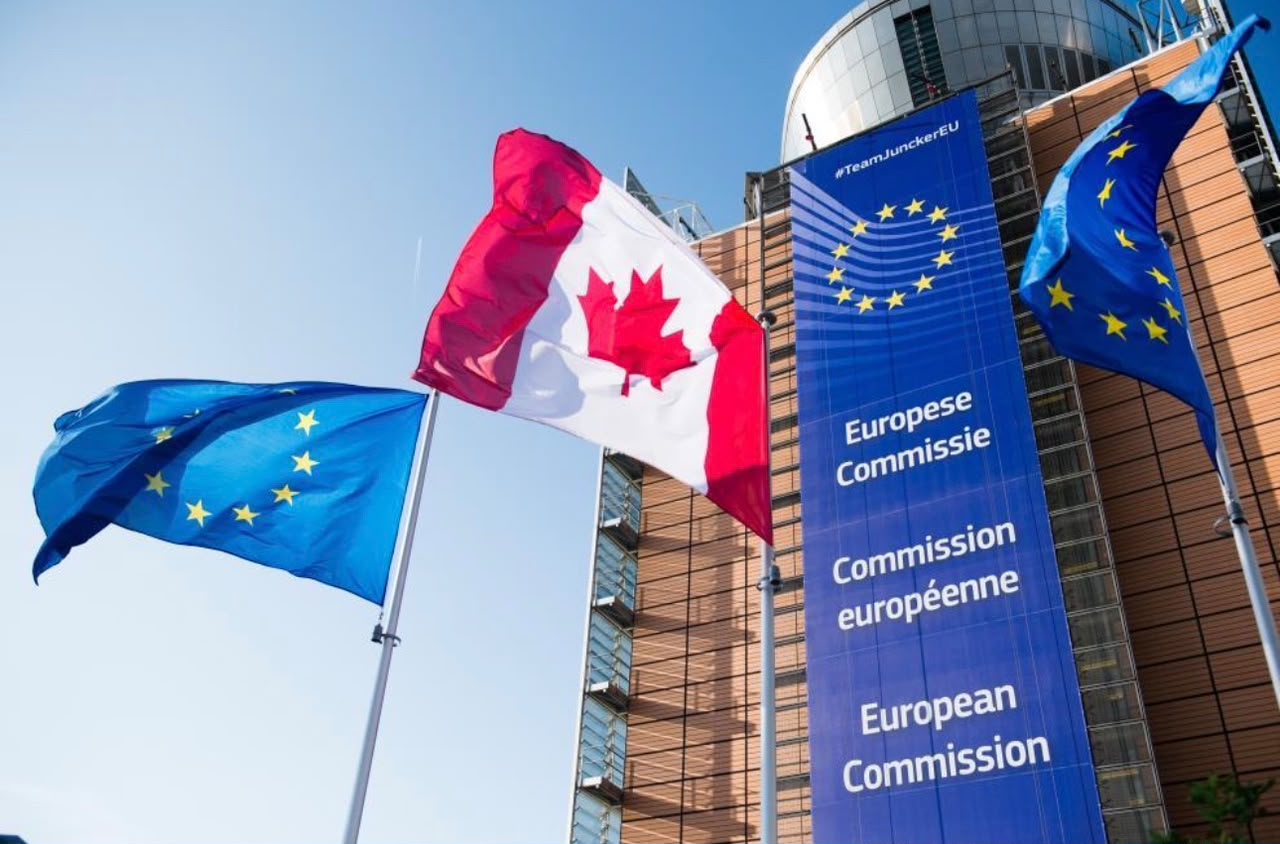

Germany proposed associate membership for Ukraine in May; it was withheld under pushback from member states and Kyiv’s own objections. In September the same status was offered to Canada, unsolicited, on terms that appear in no Treaty. Parliament had asked the Commission for a roadmap in March. It got a word instead.
The applause arrived before the question did. When Ursula von der Leyen turned to Mark Carney in the Strasbourg hemicycle and said she would like to work with him on opening the door for Canada to be the first associate member of the EU, much of the chamber stood. She named the wider relationship an Alliance for the Future, a common prosperity and economic security space that would go beyond the existing free trade agreement. Carney left the front row and walked to the podium to shake her hand. It was the warmest passage in an address that otherwise asked Europeans to prepare for heatwaves, drone incursions, and a trade deficit with China running at a billion euro a day.
It was also the only moment at which the Commission proposed a new grade of belonging to the Union. That is worth reading more slowly than a standing ovation allows, and the place to begin is not with the speech but with the instrument that preceded it.
Parliament Had Already Said What it Wanted
On 11 March this year the European Parliament adopted a recommendation on enhanced EU-Canada cooperation, procedure 2025/2168(INI), by 482 votes to 108 with 42 abstentions. It is a detailed text. It calls for intensified dialogue at multiple levels, joint work on artificial intelligence, energy, climate, and cybersecurity, and a roadmap to carry out the security and defence partnership in full. In Parliament’s own account of the vote, it also calls for accelerated ratification of CETA and stronger energy ties. The rapporteur, Tobias Cremer, described Canada as perhaps the most European country outside Europe and asked for the alignment to be turned into a deeper alliance.
What the House did not ask for is visible across the full adopted resolution, P10_TA(2026)0078, roughly sixty operative recommendations running from institutional dialogue through defence, the Arctic, trade, and digital cooperation. None proposes a differentiated status, an associate category, or anything resembling membership. What the text asks for is programmatic: full implementation of the Security and Defence Partnership, deeper integration into the Union’s defence industrial base, a standalone digital trade agreement alongside CETA, and, in its own words, urging the ten member states that have not yet ratified CETA to do so swiftly. It asked for delivery on the architecture that already exists. Six months later the Commission answered with a noun.
Associate Membership Is Not in the Treaties, and the Choice Is Not Binary
Article 49 of the Treaty on European Union opens membership to European states. Canada is not one, which Ottawa has never contested. Article 217 of the Treaty on the Functioning of the European Union lets the Union conclude with a third country an agreement establishing an association, carrying reciprocal rights and obligations, common action, and special procedures. That is the whole vocabulary the Treaties supply for a status above ordinary cooperation and below membership. Association is in it. Membership is in it. Associate membership is not.
It would be a mistake to read the offer as resolving to only two outcomes, Article 217 or treaty change. A third, more modest possibility fits the evidence at least as well, and a specialist reading of the announcement has already made the case for it. Canada is already an associated country to Horizon Europe, the Union’s research programme, and the only non-European participant at the European Space Agency, a relationship dating to 1979. It has now signed onto SAFE as well. None of that required Article 217. Each is a sector-specific accession to a defined activity, agreed on published terms, that leaves Canadian domestic law untouched outside that activity. The trade law scholar Barry Appleton, writing days before the speech, drew this distinction between what he called programme association, a subscription, and treaty association under Article 217, which he characterised as an economic constitution whose central obligation is adaptation to European norms rather than genuine reciprocity. His reading of the same briefings this piece draws on, naming defence, space, and scientific research as the areas under discussion, is that all three are programmes Canada already belongs to, which points toward deepening the subscription rather than opening the constitution.
That reading has support beyond one analyst. Tinatin Akhvlediani, who heads EU enlargement research at the Centre for European Policy Studies in Brussels, told CNN in the days after the speech that associate membership simply does not exist as a category, distinguishing it from the association agreements already held by Ukraine, Moldova, and Georgia. The German government, through a spokesperson, separately questioned whether associate member was even the right term, while saying Berlin remained open to discussing new partnership models with Ottawa, a caution that reads differently once the term’s own recent history in Berlin’s hands is known.
So the honest position is not that the offer must be Article 217 or nothing. It is that the Commission has reached for a phrase with no defined content and has not yet said which of at least three available instruments it intends: an expanded set of programme associations that would create no new legal category at all, an Article 217 agreement that would make Canada a peer of Ukraine and Chile in Union external relations law, or genuine treaty change, requiring unanimity among twenty-seven states and, in several of them, a referendum. Neither the published text of the address nor the material issued alongside it says which, and the sectors it does name, from intelligent manufacturing to the Arctic to artificial intelligence, span both the programme model and genuine common policy, so the list itself does not settle the question. The EU-Canada summit opens in Canada on 29 October. Six weeks is time enough for the Commission to say which instrument it means.
Carney has already answered the narrower question on the record, four days before the speech. Asked about EU membership on the red carpet at the Toronto International Film Festival, he said plainly: we are not looking to become a member of the European Union. He described the objective instead as a unique alliance between Canada and the European Union, grounded in shared values and complementary strengths. A senior government source separately told CTV News that reporting on the arrangement overstated what was happening, and a second official told CBC News, speaking on background, that Ottawa had weighed the associate member label among a few options and had not proposed it, framing the term as Brussels’ choice rather than Ottawa’s. Jonathan Wilkinson, Canada’s ambassador-designate to the EU, put the same point on the record the day before the speech: Canada is not seeking full membership, he said, because that would mean surrendering some sovereignty. The Union’s own ambassador to Canada, Geneviève Tuts, had described the shape of the relationship five days earlier without using the phrase at all, calling it something unique and distinct from the arrangements with Switzerland, Norway, or the United Kingdom, and cautioning that Strasbourg would open a discussion rather than close one.
The Category Already Has a Record
The claim to be first does not survive the archive either. Greece associated itself with the European Economic Community in 1961. Turkey applied for associate membership in July 1959, and the Community’s answer was to propose association as an interim arrangement on the road to accession. That produced the Ankara Agreement, signed on 12 September 1963 and concluded on the Community side by Council Decision 64/732/EEC, in force from the following December.
Sixty-three years and four days separate that signature from the speech in Strasbourg. Athens converted its association into membership in 1981. Ankara converted its association into a customs union in 1996 and has converted it into nothing since; accession talks opened in 2005 and have been stalled for most of the years that followed. Turkey’s own official history of the relationship still describes full membership as the purpose of the 1963 text.
That is the performance history of associate membership as an instrument. For one country it was a corridor. For the other it became a residence. Which of the two the Commission has in mind is a fair question for Ottawa to put, and Ankara is entitled to hear the answer on the same day.
What The Applicants Heard on The Same Morning
Enlargement appeared once in the address, in French, close to the end, after the passages on children and social media. The Union will shortly propose roadmaps for the most advanced candidates. The process will stay founded on merit. Respect for the Union’s values is not open to negotiation. Then came the condemnation of the Mladic funeral in Belgrade, which was deserved and which was also the only concrete thing said to a candidate country all morning.
Set that beside the Canadian passage, which named intelligent manufacturing, a technology alliance, integrated defence industrial bases, the Arctic as a joint flagship, energy, critical minerals, batteries, artificial intelligence, quantum, cyber, and economic security. One of those is a work programme. The other is a description of a procedure.
The states inside that procedure asked to be there, and the Council’s record shows what asking buys. Ukraine opened the fundamentals cluster on 15 June this year and the external relations cluster on 14 July, at four accession conferences held in a single day. Two clusters out of six. Montenegro, negotiating since 2012, has opened all thirty-three chapters and provisionally closed eighteen. Albania has opened all thirty-three and closed three. Serbia has not moved in any real sense since 2021. North Macedonia has held candidate status since 2005. Canada has not applied, could not apply under Article 49, and says it is not seeking membership.
None of this is an argument against helping Canada, and the substance is already flowing on terms the Council itself has recorded. Canada signed its participation in the Union’s SAFE defence procurement instrument on 14 February, the first non-European state to do so, against a Canadian financial contribution of ten million euro; the Council formally concluded the agreement on 15 June. It is an argument about sequence, and about what the Union is signalling to the people who have been waiting. A Commission that can coin a new grade of association for a country that never requested one will struggle to keep telling applicants that nothing exists between the antechamber and the table.
The word itself has a recent history inside that queue, and it is not a flattering one for what Canada has just been handed. On 18 May, Chancellor Friedrich Merz proposed, in a letter to the presidents of the Commission and the European Council, that Ukraine be granted associate membership: attendance at Council, Commission, and Parliament meetings without a vote, and phased access to Union-funded programmes, explicitly framed as going further than the Association Agreement Kyiv already holds. The proposal needed no treaty change, resting instead on a political agreement among the twenty-seven. It stalled. Several capitals pushed back, and, by Reuters’ account of the reaction in Kyiv, Ukraine itself came to regard the offer as unfair, since it would have left Ukrainian representatives sitting in rooms whose decisions they could not vote on. Four months later, the same word was offered to a country that has not applied for membership at all, arrived without the specifics that sank the Ukrainian version, and produced a standing ovation rather than a diplomatic complaint.
The Ratification Wall, in The Commission’s Own Numbers
There is a practical test available, and the Union is failing it in public. By the Commission’s own published statement of the position, seventeen member states have completed national ratification of CETA and ten have not: Belgium, Bulgaria, Cyprus, France, Greece, Hungary, Ireland, Italy, Poland, and Slovenia. That is nine years after provisional application began, and the list is more awkward than the usual shorthand about French and Italian farmers suggests. It includes the host state of the institutions.
An Article 217 association agreement would be a mixed agreement as well. It would travel through the same twenty-seven parliaments, and in Belgium through the same regional assemblies, that have not finished with the last one. Parliament asked in March for that ratification to be accelerated. The March instruction remains unexecuted, and a larger instrument has now been promised on top of it.
What Brussels Owes Before The Summit
The undefined word has already produced its first casualty of precision: a fight over what it means before anyone has said. Overnight, Donald Trump called the idea “laughable” and warned of very serious new tariffs on Europe if associate membership for Canada were carried out as what he termed a hostile act. The Commission’s response, issued through a spokesperson, did not engage the legal question at all: the proposed strengthening of the partnership with Canada, it said, is not against anyone else, but for our common strength. That is a fair answer to a geopolitical threat. It is not an answer to the institutional one this piece has been asking since Wednesday, and the two should not be allowed to merge into a single argument about intentions when the open question is about instruments.
Three things would turn Wednesday’s sentence into policy. The first is a written statement of the legal basis, published before the summit convenes. If the instrument is Article 217, the Commission should say so plainly and retire the word member, which in Union law describes rights this arrangement will not confer.
The second is an account of content: what the status grants and what it withholds. No seat in the Council, no vote, no Commissioner, no seats in Parliament, no free movement of persons unless somebody intends to negotiate one. Canadian officials can read a treaty. It is Canadian voters who will hear the word member and reasonably assume it carries weight, and there is measured public appetite for it. Nanos Research’s own published methodology records a hybrid telephone and online survey of 1,099 Canadians for the Globe and Mail between 31 March and 4 April, accurate to three points nineteen times in twenty; the Globe’s reporting of the same survey put the topline at 57 per cent supporting or somewhat supporting full membership, 32 per cent opposed, and 12 per cent unsure. A label that promises more than the instrument delivers will be read against that number.
The third is the harder one. The same inventiveness should be turned toward the queue. If associate membership can be designed in a fortnight for a transatlantic partner, the Union owes the candidate states a serious paper on why phased single market access, sectoral integration before accession, or participation in Union programmes without a vote have been unavailable to them for twenty years. Roadmaps for the most advanced candidates are not that paper. They are a promise to produce a schedule.
Carney addressed the Parliament on Thursday morning, received warmly, as expected. But the thing offered to him on Wednesday is, for the moment, a name with no instrument behind it, delivered by a Commission that has not yet carried out the instruction the same Parliament gave it in March, and now defended against a foreign leader’s tariff threat rather than clarified on its own legal terms. The chamber applauded a sentence, and the sentence is the easy part. Europe has known since 1963 how long a country can be asked to wait for the rest of it.
ABOUT THE AUTHOR
Ivana Stojanović is a Senior Analyst and Policy Analyst specialising in external relations and diplomacy. She writes on European foreign policy, diplomatic strategy, multilateral alliances, and international security cooperation for The European Post.