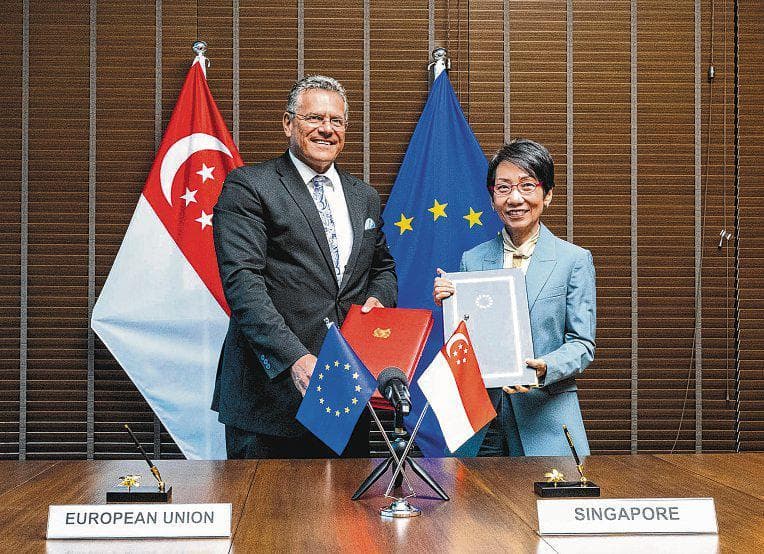
Changi: Freight agents at Singapore’s airport have filed customs paperwork electronically for years, so when Europe’s first standalone digital trade agreement entered into force on 1 February 2026, most of them noticed nothing at all. That reaction misreads what the deal does. It does not change how Singapore behaves today. It removes Singapore’s ability to behave differently tomorrow.
The EU-Singapore Digital Trade Agreement sits on top of the free trade agreement the two sides brought into force in 2019. It bans customs duties on electronic transmissions permanently rather than through the rolling moratorium that World Trade Organization members renew and threaten to drop every two years. It prohibits unjustified data localisation requirements. It rules out forcing a company to hand over source code as the price of market entry. It guarantees that electronic signatures, contracts and invoices count as valid documents on both sides.
None of those commitments describes a problem Singapore currently creates. Singapore already runs one of the most open digital regimes in Asia, and its trade ministry framed the agreement as confirmation of a direction it had chosen anyway. Critics read that as proof the deal costs Singapore nothing and therefore proves nothing.
The criticism mistakes what a standstill obligation does. Governments rarely impose localisation rules in calm periods. They impose them after a data breach, a foreign court order, or a political argument about who holds citizens’ records. A binding treaty commitment matters precisely at that moment, because it converts a domestic policy question into a treaty violation with a dispute settlement route attached. European firms buying cloud capacity in Singapore are not paying for today’s rules. They are buying insurance against a rewrite.
Brussels has a second, less discussed reason to value the text. Negotiators now carry a finished, ratified model into every other conversation in the region. Digital chapters in talks with several Asian partners borrow the same architecture, and a live agreement carries more weight in a negotiating room than a Commission position paper. Singapore, which signs digital economy agreements with almost everyone, gains a European reference point for the same reason.
Two limits deserve honest statement. First, the agreement does not create a data adequacy decision. Personal data still moves from Europe to Singapore under European data protection law, and the treaty explicitly leaves that regime untouched. Companies that expected the deal to simplify their transfer paperwork were reading the wrong instrument. Second, nobody has tested the enforcement route. The obligations ride on the dispute settlement machinery of the 2019 agreement, and until a government actually invokes it against a digital measure, the deterrent value rests on assumption rather than precedent.
Seven months of operation give little to measure. Trade statistics will not isolate the effect of a paperless clause from the rest of a growing services relationship, and the Commission has published no baseline against which to judge one. The useful metric runs the other way. Watch whether any partner in the region now accepts a data localisation ban in its own negotiations with Europe, and whether European firms cite the Singapore text when they push back against a proposed rule elsewhere in Asia.
The agreement will look trivial for as long as nothing goes wrong. That is what a well drafted standstill clause looks like when it works.