Frankfurt am Main: The AMLA OLAF cooperation agreement signed on 21 October 2026 gives the EU’s new anti-money laundering authority and its anti-fraud office a formal channel to share what they know about financial crime. The working arrangement, announced in a joint press release from Frankfurt, links the work of two bodies that until now operated on separate tracks.
The Authority for Anti-Money Laundering and Countering the Financing of Terrorism, known as AMLA, was created by Regulation (EU) 2024/1620. Article 94 of that regulation requires it to conclude working arrangements with OLAF, Europol, Eurojust and the European Public Prosecutor’s Office. The AMLA OLAF cooperation document is the latest of these arrangements, and it sets out how the two bodies will trade operational and strategic information, including criminal patterns, emerging trends, risk indicators and crime prevention methods.
Under the arrangement, OLAF will contribute anti-fraud expertise to joint analyses that AMLA coordinates. That contribution applies only where the analyses touch OLAF’s mandate and only with the consent of the national Financial Intelligence Units taking part. The two sides will also support joint operational analysis of money laundering tied to fraud involving EU funds, and they will cross-check the results against information OLAF supplies so that potential matches surface early.
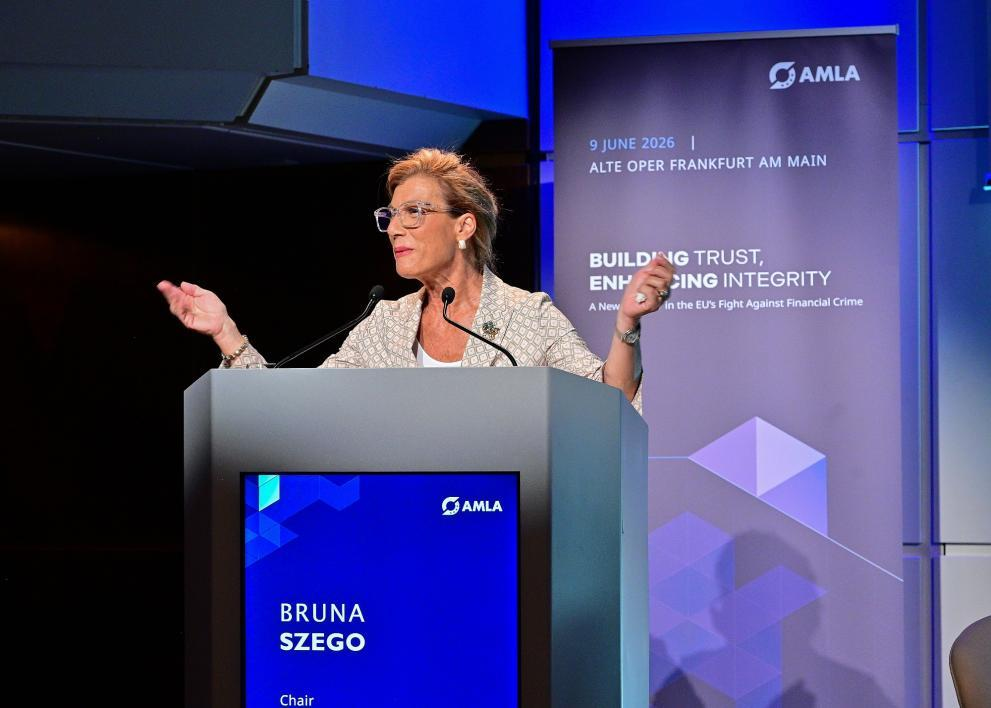
Bruna Szego, the chair of AMLA, framed the deal as a response to the way criminal networks operate. “Criminals do not respect institutional boundaries, and neither can our response,” she said. Petr Klement, the Director-General of OLAF, pointed to national Financial Intelligence Units as a rich source of banking and cash transaction data that could trigger or support OLAF investigations. He described the aim as better results, including higher recoveries of misused EU money.
The timing matters for the EU budget, and the AMLA OLAF cooperation fits the pattern of recent OLAF work. OLAF’s 2025 report, presented in April 2026, recommended recovering €597 million of misused funds and opened 254 new investigations. That report also asked for closer links with the Anti-Money Laundering Authority and the Financial Intelligence Units of the Member States, and the AMLA OLAF cooperation now starts to deliver that request. OLAF has also been preparing for the next multiannual budget, and on 8 October it convened anti-fraud experts at a conference on protecting that budget.
The arrangement has limits. Article 94 states that such documents cannot serve as a basis for exchanging personal data, and the press release gives no figures, no cost and no date for the first joint analyses. Those details will decide whether the AMLA OLAF cooperation produces cases or remains a statement of intent. For now, the 2026 agreement gives investigators a clearer route from suspicious financial flows to fraud involving EU funds, and it gives the EU budget one more line of defence.