August 9, 2026
LATEST
New EU Gas Market Rules Take Effect With Consumer SafeguardsDeforestation Regulation Holds Its December Deadline Despite CutsDigital Omnibus Delays Europe’s High-Risk AI Deadline to 2027Europe’s Schools Confront a Widening Basic Skills GapRule of Law Report Finds Progress but Trust Still LagsIRIS2 Gains 66 Satellites as Brussels Signs the Rollout DealNature Restoration Plans Come Due as Member States Race a DeadlineECB Rates Hold at 2.25 Percent as Frankfurt Waits on the DataEU Budget Talks Turn to Cohesion as Ireland Takes OverWildfire Response Stretches Europe’s Emergency Fleet ThinCan Europe’s Quantum Plan Match Its Big Ambitions?Armenia Edges West as Moscow’s Grip Slips AwayEurope Inherits the World’s Aid Bill It Cannot Fully PayAir Passenger Rights Get Their First Overhaul in Two DecadesErasmus Opens a 5 Billion Euro Round for Skills and MobilityCeuta Crisis Pushes the EU Toward Faster Migrant ReturnsBulky Parcels Face a Packaging Crackdown From August 12Can Europe Build Its Drone Wall Before 2030 Arrives?Indonesia’s Trade Deal With Europe Nears Its Final SignatureEurope Leans on Beijing to Keep Climate Talks Alive Before AntalyaNew EU Gas Market Rules Take Effect With Consumer SafeguardsDeforestation Regulation Holds Its December Deadline Despite CutsDigital Omnibus Delays Europe’s High-Risk AI Deadline to 2027Europe’s Schools Confront a Widening Basic Skills GapRule of Law Report Finds Progress but Trust Still LagsIRIS2 Gains 66 Satellites as Brussels Signs the Rollout DealNature Restoration Plans Come Due as Member States Race a DeadlineECB Rates Hold at 2.25 Percent as Frankfurt Waits on the DataEU Budget Talks Turn to Cohesion as Ireland Takes OverWildfire Response Stretches Europe’s Emergency Fleet ThinCan Europe’s Quantum Plan Match Its Big Ambitions?Armenia Edges West as Moscow’s Grip Slips AwayEurope Inherits the World’s Aid Bill It Cannot Fully PayAir Passenger Rights Get Their First Overhaul in Two DecadesErasmus Opens a 5 Billion Euro Round for Skills and MobilityCeuta Crisis Pushes the EU Toward Faster Migrant ReturnsBulky Parcels Face a Packaging Crackdown From August 12Can Europe Build Its Drone Wall Before 2030 Arrives?Indonesia’s Trade Deal With Europe Nears Its Final SignatureEurope Leans on Beijing to Keep Climate Talks Alive Before Antalya
August 9, 2026
LATEST
New EU Gas Market Rules Take Effect With Consumer SafeguardsDeforestation Regulation Holds Its December Deadline Despite CutsDigital Omnibus Delays Europe’s High-Risk AI Deadline to 2027Europe’s Schools Confront a Widening Basic Skills GapRule of Law Report Finds Progress but Trust Still LagsIRIS2 Gains 66 Satellites as Brussels Signs the Rollout DealNature Restoration Plans Come Due as Member States Race a DeadlineECB Rates Hold at 2.25 Percent as Frankfurt Waits on the DataEU Budget Talks Turn to Cohesion as Ireland Takes OverWildfire Response Stretches Europe’s Emergency Fleet ThinCan Europe’s Quantum Plan Match Its Big Ambitions?Armenia Edges West as Moscow’s Grip Slips AwayEurope Inherits the World’s Aid Bill It Cannot Fully PayAir Passenger Rights Get Their First Overhaul in Two DecadesErasmus Opens a 5 Billion Euro Round for Skills and MobilityCeuta Crisis Pushes the EU Toward Faster Migrant ReturnsBulky Parcels Face a Packaging Crackdown From August 12Can Europe Build Its Drone Wall Before 2030 Arrives?Indonesia’s Trade Deal With Europe Nears Its Final SignatureEurope Leans on Beijing to Keep Climate Talks Alive Before AntalyaNew EU Gas Market Rules Take Effect With Consumer SafeguardsDeforestation Regulation Holds Its December Deadline Despite CutsDigital Omnibus Delays Europe’s High-Risk AI Deadline to 2027Europe’s Schools Confront a Widening Basic Skills GapRule of Law Report Finds Progress but Trust Still LagsIRIS2 Gains 66 Satellites as Brussels Signs the Rollout DealNature Restoration Plans Come Due as Member States Race a DeadlineECB Rates Hold at 2.25 Percent as Frankfurt Waits on the DataEU Budget Talks Turn to Cohesion as Ireland Takes OverWildfire Response Stretches Europe’s Emergency Fleet ThinCan Europe’s Quantum Plan Match Its Big Ambitions?Armenia Edges West as Moscow’s Grip Slips AwayEurope Inherits the World’s Aid Bill It Cannot Fully PayAir Passenger Rights Get Their First Overhaul in Two DecadesErasmus Opens a 5 Billion Euro Round for Skills and MobilityCeuta Crisis Pushes the EU Toward Faster Migrant ReturnsBulky Parcels Face a Packaging Crackdown From August 12Can Europe Build Its Drone Wall Before 2030 Arrives?Indonesia’s Trade Deal With Europe Nears Its Final SignatureEurope Leans on Beijing to Keep Climate Talks Alive Before Antalya

Export Engine Stalls As Europe’s Trade Surplus Shrinks Sharply

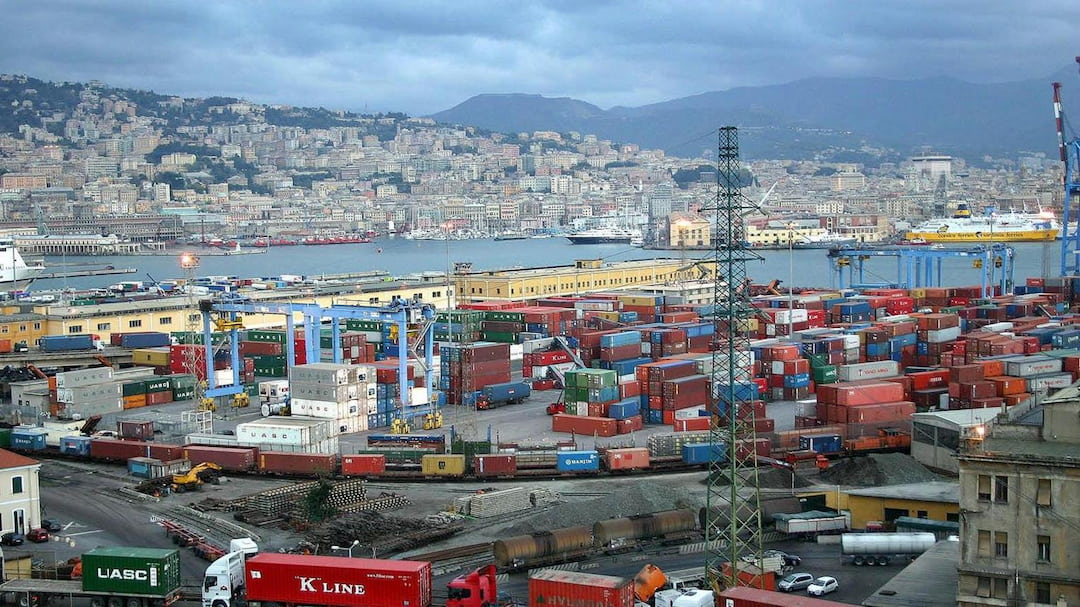
Genoa: From the container cranes of this Ligurian port, where a large share of Italy’s seaborne trade passes on its way to the rest of the world, the strain on Europe’s export machine is becoming visible in the data. Figures released by Eurostat show the euro area’s trade surplus in goods has collapsed to a fraction of what it was a year ago, a quiet but telling sign of how tariff tensions and sluggish demand are reshaping the continent’s economic standing.

The numbers are stark. In March the euro area recorded a surplus of 7.8 billion euros in trade with the rest of the world, down from 34.1 billion in the same month a year earlier. Over the first quarter as a whole, exports contracted by 0.1 percent, the fourth consecutive quarterly decline, while imports rose by 1.7 percent, ending three straight quarters of contraction. The combination, weaker sales abroad and a renewed appetite for foreign goods at home, has eaten away at a surplus that European policymakers have long treated as a structural strength and a buffer against external shocks.

Statisticians and economists trace much of the deterioration to the trade frictions that have unsettled global commerce over the past year. Tariff disputes have raised the cost and uncertainty of selling into key markets, prompting some manufacturers to front-load shipments earlier and then pull back, distorting the quarterly pattern. The broader picture is of an export-dependent economy struggling to find buyers at a moment when its largest trading partners are turning inward, and when the strong euro has made European goods dearer on world markets.

The trade figures arrive alongside other indicators that complicate the mood. Industrial production crept up by just 0.2 percent in the euro area in March compared with the previous month, but remained more than two percent lower than a year earlier, confirming that the bloc’s factories are running well below their recent peak. Inflation, meanwhile, has proved stubborn, with the annual rate climbing to an estimated 3.2 percent in May from three percent in April, driven largely by a sharp jump in energy costs. For a central bank weighing when and whether to ease policy, the mix of softening growth and sticky prices offers little comfort.

What unsettles economists most is the trajectory rather than any single month. A halving of the trade surplus in a year is not a rounding error; it reflects a sustained loss of momentum in the sector that has underpinned the prosperity of Europe’s industrial heartland. Germany’s export-led model, mirrored to varying degrees across the north and centre of the bloc, was built for a world of open markets and rising global demand. That world has grown more hostile, and the figures from the first quarter suggest the adjustment is already under way rather than a distant risk.

Officials caution against reading too much into volatile monthly data, and a single strong quarter could narrow the gap again. Yet the pattern of four successive quarters of falling exports is harder to dismiss as noise. It points to a structural challenge that no statistical revision will smooth away: a continent that has prospered by selling to the world is discovering how exposed that strategy becomes when the world stops buying. The cranes of Genoa keep moving, but the cargo they handle is telling a story of an export engine losing its power.