August 9, 2026
LATEST
New EU Gas Market Rules Take Effect With Consumer SafeguardsDeforestation Regulation Holds Its December Deadline Despite CutsDigital Omnibus Delays Europe’s High-Risk AI Deadline to 2027Europe’s Schools Confront a Widening Basic Skills GapRule of Law Report Finds Progress but Trust Still LagsIRIS2 Gains 66 Satellites as Brussels Signs the Rollout DealNature Restoration Plans Come Due as Member States Race a DeadlineECB Rates Hold at 2.25 Percent as Frankfurt Waits on the DataEU Budget Talks Turn to Cohesion as Ireland Takes OverWildfire Response Stretches Europe’s Emergency Fleet ThinCan Europe’s Quantum Plan Match Its Big Ambitions?Armenia Edges West as Moscow’s Grip Slips AwayEurope Inherits the World’s Aid Bill It Cannot Fully PayAir Passenger Rights Get Their First Overhaul in Two DecadesErasmus Opens a 5 Billion Euro Round for Skills and MobilityCeuta Crisis Pushes the EU Toward Faster Migrant ReturnsBulky Parcels Face a Packaging Crackdown From August 12Can Europe Build Its Drone Wall Before 2030 Arrives?Indonesia’s Trade Deal With Europe Nears Its Final SignatureEurope Leans on Beijing to Keep Climate Talks Alive Before AntalyaNew EU Gas Market Rules Take Effect With Consumer SafeguardsDeforestation Regulation Holds Its December Deadline Despite CutsDigital Omnibus Delays Europe’s High-Risk AI Deadline to 2027Europe’s Schools Confront a Widening Basic Skills GapRule of Law Report Finds Progress but Trust Still LagsIRIS2 Gains 66 Satellites as Brussels Signs the Rollout DealNature Restoration Plans Come Due as Member States Race a DeadlineECB Rates Hold at 2.25 Percent as Frankfurt Waits on the DataEU Budget Talks Turn to Cohesion as Ireland Takes OverWildfire Response Stretches Europe’s Emergency Fleet ThinCan Europe’s Quantum Plan Match Its Big Ambitions?Armenia Edges West as Moscow’s Grip Slips AwayEurope Inherits the World’s Aid Bill It Cannot Fully PayAir Passenger Rights Get Their First Overhaul in Two DecadesErasmus Opens a 5 Billion Euro Round for Skills and MobilityCeuta Crisis Pushes the EU Toward Faster Migrant ReturnsBulky Parcels Face a Packaging Crackdown From August 12Can Europe Build Its Drone Wall Before 2030 Arrives?Indonesia’s Trade Deal With Europe Nears Its Final SignatureEurope Leans on Beijing to Keep Climate Talks Alive Before Antalya
August 9, 2026
LATEST
New EU Gas Market Rules Take Effect With Consumer SafeguardsDeforestation Regulation Holds Its December Deadline Despite CutsDigital Omnibus Delays Europe’s High-Risk AI Deadline to 2027Europe’s Schools Confront a Widening Basic Skills GapRule of Law Report Finds Progress but Trust Still LagsIRIS2 Gains 66 Satellites as Brussels Signs the Rollout DealNature Restoration Plans Come Due as Member States Race a DeadlineECB Rates Hold at 2.25 Percent as Frankfurt Waits on the DataEU Budget Talks Turn to Cohesion as Ireland Takes OverWildfire Response Stretches Europe’s Emergency Fleet ThinCan Europe’s Quantum Plan Match Its Big Ambitions?Armenia Edges West as Moscow’s Grip Slips AwayEurope Inherits the World’s Aid Bill It Cannot Fully PayAir Passenger Rights Get Their First Overhaul in Two DecadesErasmus Opens a 5 Billion Euro Round for Skills and MobilityCeuta Crisis Pushes the EU Toward Faster Migrant ReturnsBulky Parcels Face a Packaging Crackdown From August 12Can Europe Build Its Drone Wall Before 2030 Arrives?Indonesia’s Trade Deal With Europe Nears Its Final SignatureEurope Leans on Beijing to Keep Climate Talks Alive Before AntalyaNew EU Gas Market Rules Take Effect With Consumer SafeguardsDeforestation Regulation Holds Its December Deadline Despite CutsDigital Omnibus Delays Europe’s High-Risk AI Deadline to 2027Europe’s Schools Confront a Widening Basic Skills GapRule of Law Report Finds Progress but Trust Still LagsIRIS2 Gains 66 Satellites as Brussels Signs the Rollout DealNature Restoration Plans Come Due as Member States Race a DeadlineECB Rates Hold at 2.25 Percent as Frankfurt Waits on the DataEU Budget Talks Turn to Cohesion as Ireland Takes OverWildfire Response Stretches Europe’s Emergency Fleet ThinCan Europe’s Quantum Plan Match Its Big Ambitions?Armenia Edges West as Moscow’s Grip Slips AwayEurope Inherits the World’s Aid Bill It Cannot Fully PayAir Passenger Rights Get Their First Overhaul in Two DecadesErasmus Opens a 5 Billion Euro Round for Skills and MobilityCeuta Crisis Pushes the EU Toward Faster Migrant ReturnsBulky Parcels Face a Packaging Crackdown From August 12Can Europe Build Its Drone Wall Before 2030 Arrives?Indonesia’s Trade Deal With Europe Nears Its Final SignatureEurope Leans on Beijing to Keep Climate Talks Alive Before Antalya

Is The Mercosur Pact Really In Force Or Just On Paper

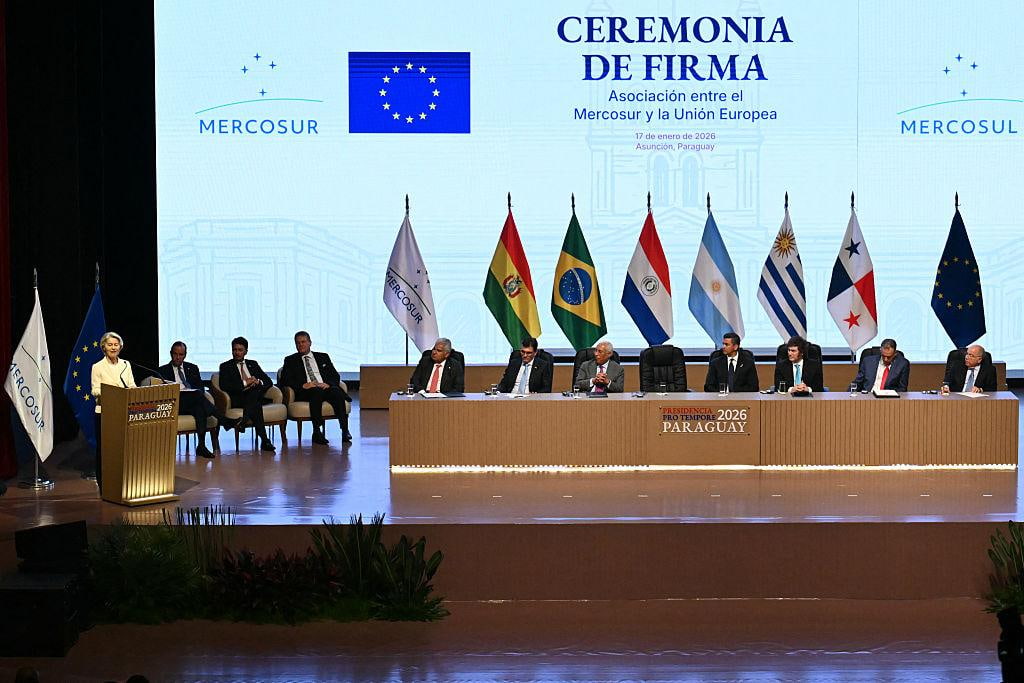
Brussels: Since the first of May, European exporters have been able to trade with Argentina, Brazil, Paraguay and Uruguay on the new terms of the EU-Mercosur agreement, even though most Europeans would struggle to say whether the deal is law. That ambiguity is deliberate, and it sits at the centre of one of the most consequential trade fights the bloc has had in a quarter of a century. The agreement is being applied provisionally while the question of whether it can lawfully be applied at all is still being argued.

The mechanics explain the strange half-life. The Commission split the package into a broad partnership agreement, which requires ratification by every national parliament before it fully enters into force, and an interim trade agreement that the Council could approve by qualified majority and bring into provisional application without waiting for all twenty-seven. In January the Council gave its green light by twenty-one votes to five, with Austria, France, Hungary, Ireland and Poland against and Belgium abstaining. That majority was enough to switch the tariff cuts on. It was not enough to settle the politics.

The opposition has not gone quiet simply because the deal is operating. French farm groups remain the loudest critics, arguing that South American beef, poultry and sugar produced under looser environmental and animal-welfare rules will undercut European producers held to stricter standards. Defenders counter that the agreement opens a market of more than 260 million consumers to European cars, machinery, wine and chemicals, and locks in a strategic partnership at a moment when Washington’s trade posture has grown unpredictable and Beijing’s footprint in Latin America keeps expanding. Both arguments are real, and provisional application has the effect of testing them in the field before parliaments deliver their verdict.

The legal cloud is the more interesting story. In January the European Parliament voted, by the wafer-thin margin of 334 to 324, to ask the European Court of Justice whether a trade agreement of this scope may be provisionally applied before national ratification is complete. That referral does not stop the clock, but it hangs over every shipment cleared under the new tariffs. Should the Court find that the Commission and Council stretched their competence too far, the bloc would face the awkward task of unwinding benefits that companies have already begun to rely on, and the institutional bruising would outlast any single trade flow.

For business the calculation is pragmatic. A provisionally applied agreement delivers most of the commercial upside immediately, since the tariff schedule is what moves goods, while the unratified partnership chapters on political dialogue and sustainability commitments wait in a longer queue. Exporters are unlikely to turn down lower duties because the legal foundation is contested. Yet provisional application also means the gains are reversible in a way that a fully ratified treaty would not be, which injects a quiet uncertainty into investment decisions that depend on the terms holding for years rather than months.

The deeper significance is constitutional as much as commercial. By moving the trade pillar ahead of full ratification, the Commission has shown it can deliver market access without every capital’s consent, a capability that makes the bloc a more agile negotiating partner. The same manoeuvre strains the consent of member states whose parliaments now find themselves ratifying an agreement already shaping their economies. How the Court resolves that tension will tell future trading partners whether Europe can commit quickly or whether any deal remains hostage to twenty-seven domestic ratifications.

For now the agreement lives in an in-between state, legally provisional, commercially active and politically unresolved. Goods are crossing under the new terms while the institutions argue over whether they should be. It is a revealing snapshot of how the modern bloc actually conducts trade policy, by acting first and litigating the legitimacy of the action afterward.