
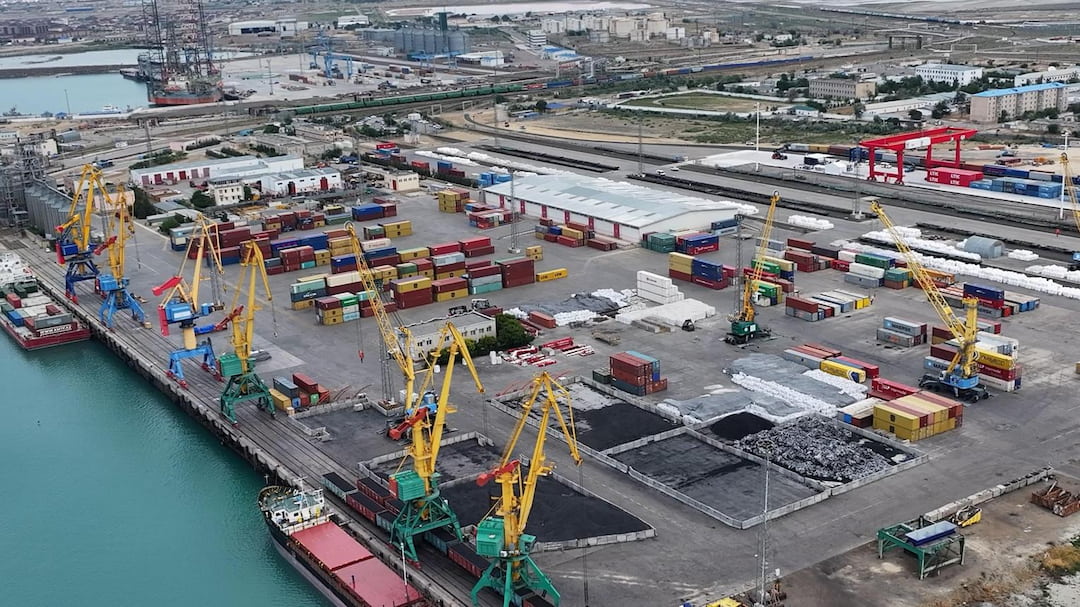
Aktau: The container hub that opened at this Kazakh port on the eastern shore of the Caspian handles 140,000 twenty-foot units a year in its first phase, and a second phase due in 2027 or 2028 should lift that to 240,000. Those are respectable numbers for a facility that barely functioned as a container port five years ago. They also show that Europe’s alternative route to Asia now depends less on summit declarations than on dredgers, berths and ferries.
The Middle Corridor runs from China across Kazakhstan, over the Caspian by ship, through the South Caucasus and into Europe. Its appeal is simple, because it avoids Russian territory. Brussels grasped that quickly. At the Global Gateway investors forum in January 2024 the European Union pledged 10 billion euro for corridor infrastructure, and after the first EU-Central Asia summit in Samarkand in April 2025 it added a further 3 billion. Kazakhstan’s president travelled to Brussels in June 2026 and signed a fresh set of connectivity and critical raw materials agreements, which officials framed as the corridor moving from ambition to delivery.
The traffic is growing. Container transit through Kazakhstan’s Caspian ports rose 3.8-fold between 2022 and 2025. The national shipping company carried 59,400 twenty-foot units on the Aktau to Baku feeder route last year, more than 15 percent above 2024. In May this year the Aktau to Azerbaijan link recorded 7,451 units in a single month, a company record, and China to Europe volumes on the route climbed roughly 30 percent in the first five months of 2026.
Growth of that kind meets physical limits fast. The World Bank identifies port capacity, rail access and delays at the Kazakhstan-Uzbekistan border as the corridor’s main constraints, and none of those yields to a financing pledge alone. The Caspian itself has become the awkward variable. Falling water levels stop fully loaded vessels entering some harbours, so Kazakhstan dredged Kuryk in 2025 and expects to finish similar work at Aktau by the end of this year. A shrinking sea is not a variable European infrastructure planning has had to price before.
Vessel availability compounds the problem. Aktau and Kuryk together move roughly 22 million tonnes a year, but the Caspian feeder fleet is small and ageing, and every extra container needs a slot on a ship that may not exist. Corridor operators talk about cutting transit to 15 days. That target assumes coordinated customs, synchronised rail slots and predictable sailings across three jurisdictions with different tariffs and different incentives.
Sceptics make a fair point that deserves stating plainly. Even tripled, Middle Corridor volumes remain a rounding error beside maritime shipping between Asia and Europe, and beside the northern rail route the corridor is meant to replace. A route carrying a few hundred thousand containers cannot underwrite European supply chain security on its own.
The stronger case for European money is narrower and more defensible. The corridor does not substitute for the sea. It works as an insurance policy and, more usefully, as the only realistic overland path for critical raw materials from Central Asia that avoids Russia. Brussels earmarked 2.5 billion euro of its 12 billion Central Asia package for exactly that purpose. Copper, tungsten and rare earths move in small parcels at high value, which suits a route with limited capacity and demanding reliability standards.
Judged against that purpose, the metric worth watching is not the headline pledge. It is whether the dredging finishes on schedule, whether the second Aktau phase opens in 2027, and whether the border queue into Uzbekistan shortens. Those three items will tell Europe more about its Asian connectivity than any further declaration.


