Kobe: The yards on Osaka Bay have built warships for Japan’s navy for decades under a rule that made selling them abroad effectively impossible. That rule has gone. On 21 April 2026 the government approved transfers of a far wider range of equipment, fighter aircraft and frigates with lethal capability included, to seventeen countries holding defence agreements with Tokyo. For the first time since 1945, Japanese defence exports may carry weapons.
Europe noticed quickly. France and Poland signalled interest within weeks, alongside the Philippines. Norway’s ambassador to NATO called the change valuable to Europe and to the alliance as a whole. None of that enthusiasm has yet produced a contract.
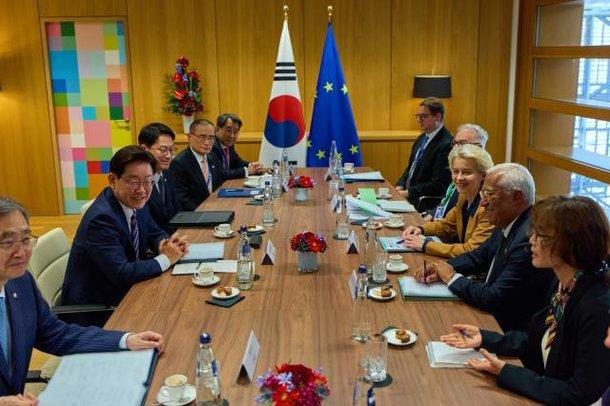
The framework for talking already exists. Japan and the European Union signed a Security and Defence Partnership in November 2024, the first the bloc concluded with any Indo-Pacific country, and held their opening dialogue under it in June 2025 across cyber, space, maritime security, disinformation and non-proliferation. Read the text and the limitation becomes obvious. It creates conversation. It does not let a European navy order a Japanese hull.
Tokyo also kept its safeguards. The National Security Council still examines each case, end-use verification remains stringent, the Diet receives disclosure, and retransfer to third parties stays restricted. Analysts at RUSI have described the reform as a loosening rather than an opening, and the distinction matters for any European planner drawing up a schedule. These procedures add quarters, not weeks.
What Europe actually needs from Japan is capacity. European shipyards are running at their limits, order books stretch past the decade, and every frigate a navy wants in 2032 competes with a submarine somebody ordered in 2024. Japan retained an industrial base that European countries allowed to atrophy: welders, integrated suppliers, yards that deliver to schedule. That is a scarcer asset than any particular platform.
The obstacle sits on the European side, and it is financial rather than diplomatic. European defence industrial instruments reward European content by design. A Japanese frigate qualifies for no European industrial programme money, so any purchase runs through a national budget and lands in a national parliament, where a minister must explain why the yard hiring locally is in Nagasaki.
That objection is serious. Governments sold rearmament to their electorates partly as industrial policy, promising jobs alongside deterrence. Ordering abroad breaks the bargain, and the yards that lose the work are the ones Europe will need in the 2040s. A shipbuilding base that shrinks because foreign hulls arrived faster is a strategic loss dressed as a procurement saving.
The rebuttal is timing. Deterrence that arrives in 2035 does not deter anything in 2028, and Europe’s shortfall is immediate. Co-production offers a partial answer, with Japanese design and European assembly, though that model demands the classified exchange and industrial agreements neither side has finished building.
The asymmetry defines the moment. Japan spent two years deciding, held a national debate, changed its framework and named the partners it will supply. Europe holds a partnership document, a set of dialogues and no decision about what it wants to buy. Tokyo has opened a door that Brussels and its capitals have not yet worked out how to walk through.