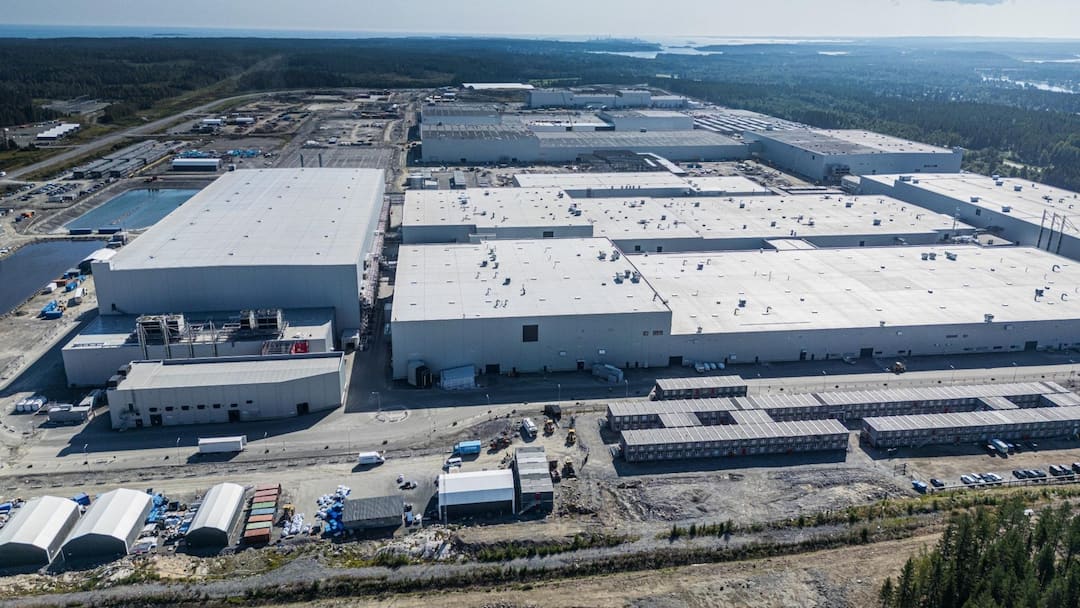
Skellefteå: Northern Sweden learned an expensive lesson about the distance between an announced battery project and a shipped cell. That lesson now shadows the Commission’s strategic projects under the Critical Raw Materials Act, and the ReSourceEU action plan that puts up to three billion euros behind them for 2026.
The Commission has narrowed its focus. From roughly sixty designated strategic projects, it has picked a sub-group capable of producing battery, rare earth and defence-related materials in the very short term. Those projects require an estimated 2.15 billion euros in combined capital and operating cost to reach production, which makes the three billion figure look adequate on paper and thin in practice once cost overruns enter the picture.
The application pipeline reveals where the bloc’s anxiety concentrates. Seventy-five projects address the battery value chain. Twenty-one target rare earth elements for permanent magnets, the components that turn wind turbines and electric motors, and a further set relates directly to defence supply. Permanent magnets deserve the attention. A single supplier country controls the separation and metallisation steps almost entirely, and no European facility currently replicates them at scale.
Regulatory fast-tracking accompanies the money. Strategic project status compresses permitting timelines, which addresses the constraint that mining executives cite most often. It does not address the two constraints they cite next, namely offtake certainty and processing capacity. A permitted mine that cannot sell forward at a workable price will not reach a final investment decision, and Europe’s magnet makers remain too few to provide that certainty.
The European Court of Auditors made the point bluntly in February 2026. Despite clear policy signals, the auditors found that many strategic projects will struggle to deliver by 2030, and they questioned whether designation and permitting relief substitute for the demand-side commitments that anchor investment. Their assessment reads less as scepticism about the strategy than as a warning that the strategy is incomplete.
Officials counter that ReSourceEU deliberately front-loads the projects nearest to production precisely because the auditors flagged the 2030 gap. Concentrating money on shovel-ready assets buys tonnes sooner, even if it favours brownfield expansion over the greenfield discoveries that would matter after 2035. That is a defensible sequencing choice, and it is also an admission that the longer horizon remains unfunded.
Skellefteå’s experience suggests the binding constraint may be neither permits nor capital. Building a plant proved achievable. Running it to specification, with trained operators and qualified output that customers would accept, proved considerably harder. Nothing in the current package addresses that industrial learning curve, and it cannot be shortened by a designation letter.
The next selection round will show whether the Commission has absorbed the auditors’ critique or simply accelerated the same approach.