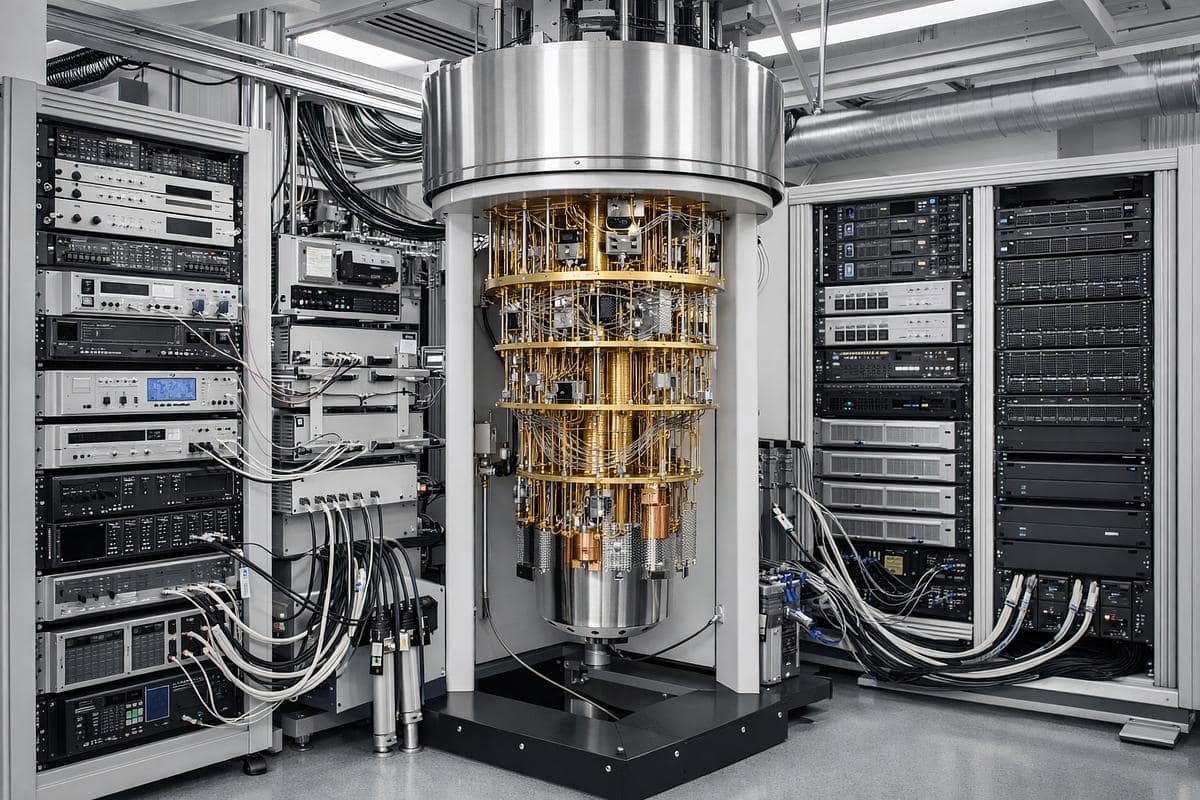
Delft: In the cooled laboratories where European physicists coax fragile qubits into holding their state for fractions of a second, the science is racing ahead of the politics. The European Commission is now trying to close that gap with a Quantum Act, a legislative initiative pencilled into its 2026 work programme, designed to turn a continent rich in research papers into one capable of building and securing the machines those papers describe.
The ambition is set out in the Quantum Europe Strategy adopted last summer, which committed the bloc to becoming a global quantum leader by 2030. The strategy was long on vision and short on instruments. The promised Act is meant to supply the missing tools, focusing on three intertwined problems: coordinating the research money that member states currently spend in scattered national programmes, lifting Europe’s industrial capacity to actually manufacture quantum hardware, and protecting the supply chains and communication networks on which any sovereign quantum capability would rest.
That third strand has acquired fresh urgency. Through late spring the Commission ran a consultation on the next phase of the European Quantum Communication Infrastructure, the satellite-and-fibre network known as EuroQCI, gathering views until 24 June on how the system should be funded from 2027. The infrastructure matters because the same technology that promises faster computation also threatens to break the encryption that guards everything from bank transfers to defence communications. A rival that builds a powerful quantum computer first could, in principle, unpick secrets that today look unbreakable. Europe wants its own quantum-safe networks in place before that day arrives.
The familiar European weakness is not invention but scale. The continent produces world-class research and a steady stream of promising start-ups, then watches the most ambitious of them drift toward American venture capital or licence their breakthroughs abroad. Talk of a European ‘Quantum Valley’ has circulated for years, but founders still complain that the capital, the procurement contracts and the manufacturing base needed to grow a hardware company simply are not there. An Act that merely adds another layer of coordination without unlocking money and demand would repeat the mistake.
That is the crux of the coming argument. Industry groups want the legislation to behave less like a regulation and more like an industrial policy, with public procurement that guarantees a market for European-made quantum systems and funding predictable enough to justify building fabrication lines. Others caution against pouring subsidy into a field where commercial applications remain uncertain and timelines keep slipping. Quantum computers that solve genuinely useful problems faster than classical machines are still, by most honest assessments, years away, and a strategy built on imminent breakthroughs risks disappointment.
There is also the question of who decides. Quantum touches defence, telecommunications, research and the single market at once, which means several Commission departments and a thicket of national ministries all have a claim. Coordinating that without smothering it in process is precisely the sort of task at which the Union has a mixed record.
For now the strategy gives Europe a destination and the consultation gives it a sense of the terrain. Whether the Quantum Act becomes the engine that carries the bloc there, or another well-intentioned framework that researchers admire and investors ignore, will depend on how much real money and market certainty lawmakers are willing to put behind the rhetoric. The physics is hard enough; the political will may prove harder still.