August 10, 2026
LATEST
Five Joint Defence Projects Launch Europe’s Military ShieldElectrification Plan Aims to Make Europe First Electro ContinentHorizon Europe Budget Fight Heats Up as Ministers Push BackGoogle’s DMA Fine Sets Off a Transatlantic Tariff ClashTwenty New University Alliances Join Erasmus for Two YearsForeign Subsidies Case Puts Temu in the EU’s SightsVan Tachographs Now Mandatory for Cross-Border FleetsStress Test Exposes Gaps in Euro Area Bank DefencesEurope Bets on a Gulf Partnership Before the Riyadh SummitWhy the Atlantic Route Now Runs Through MauritaniaKyiv and Chisinau Advance as the EU Accession Talks Gather PaceEurope’s New Digital Border System Beds In After a Rocky RolloutBrussels Mounts Its Largest Wildfire Response as the Fires SpreadRetail Spending Slipped in June, Wrong-Footing EconomistsHeatwave Warning Puts Brussels on Alert for Vulnerable GroupsKANAL’s 230 Million Euro Museum Sets a November Opening DatePension Savings Rules Get a Reset as the EU Scraps the 1% CapMedicine Shortages Move to the Heart of Europe’s Pharma ResetJapan Becomes Europe’s Closest Security Partner in AsiaCan Europe’s New Zealand Deal Anchor It in the Pacific?Five Joint Defence Projects Launch Europe’s Military ShieldElectrification Plan Aims to Make Europe First Electro ContinentHorizon Europe Budget Fight Heats Up as Ministers Push BackGoogle’s DMA Fine Sets Off a Transatlantic Tariff ClashTwenty New University Alliances Join Erasmus for Two YearsForeign Subsidies Case Puts Temu in the EU’s SightsVan Tachographs Now Mandatory for Cross-Border FleetsStress Test Exposes Gaps in Euro Area Bank DefencesEurope Bets on a Gulf Partnership Before the Riyadh SummitWhy the Atlantic Route Now Runs Through MauritaniaKyiv and Chisinau Advance as the EU Accession Talks Gather PaceEurope’s New Digital Border System Beds In After a Rocky RolloutBrussels Mounts Its Largest Wildfire Response as the Fires SpreadRetail Spending Slipped in June, Wrong-Footing EconomistsHeatwave Warning Puts Brussels on Alert for Vulnerable GroupsKANAL’s 230 Million Euro Museum Sets a November Opening DatePension Savings Rules Get a Reset as the EU Scraps the 1% CapMedicine Shortages Move to the Heart of Europe’s Pharma ResetJapan Becomes Europe’s Closest Security Partner in AsiaCan Europe’s New Zealand Deal Anchor It in the Pacific?
August 10, 2026
LATEST
Five Joint Defence Projects Launch Europe’s Military ShieldElectrification Plan Aims to Make Europe First Electro ContinentHorizon Europe Budget Fight Heats Up as Ministers Push BackGoogle’s DMA Fine Sets Off a Transatlantic Tariff ClashTwenty New University Alliances Join Erasmus for Two YearsForeign Subsidies Case Puts Temu in the EU’s SightsVan Tachographs Now Mandatory for Cross-Border FleetsStress Test Exposes Gaps in Euro Area Bank DefencesEurope Bets on a Gulf Partnership Before the Riyadh SummitWhy the Atlantic Route Now Runs Through MauritaniaKyiv and Chisinau Advance as the EU Accession Talks Gather PaceEurope’s New Digital Border System Beds In After a Rocky RolloutBrussels Mounts Its Largest Wildfire Response as the Fires SpreadRetail Spending Slipped in June, Wrong-Footing EconomistsHeatwave Warning Puts Brussels on Alert for Vulnerable GroupsKANAL’s 230 Million Euro Museum Sets a November Opening DatePension Savings Rules Get a Reset as the EU Scraps the 1% CapMedicine Shortages Move to the Heart of Europe’s Pharma ResetJapan Becomes Europe’s Closest Security Partner in AsiaCan Europe’s New Zealand Deal Anchor It in the Pacific?Five Joint Defence Projects Launch Europe’s Military ShieldElectrification Plan Aims to Make Europe First Electro ContinentHorizon Europe Budget Fight Heats Up as Ministers Push BackGoogle’s DMA Fine Sets Off a Transatlantic Tariff ClashTwenty New University Alliances Join Erasmus for Two YearsForeign Subsidies Case Puts Temu in the EU’s SightsVan Tachographs Now Mandatory for Cross-Border FleetsStress Test Exposes Gaps in Euro Area Bank DefencesEurope Bets on a Gulf Partnership Before the Riyadh SummitWhy the Atlantic Route Now Runs Through MauritaniaKyiv and Chisinau Advance as the EU Accession Talks Gather PaceEurope’s New Digital Border System Beds In After a Rocky RolloutBrussels Mounts Its Largest Wildfire Response as the Fires SpreadRetail Spending Slipped in June, Wrong-Footing EconomistsHeatwave Warning Puts Brussels on Alert for Vulnerable GroupsKANAL’s 230 Million Euro Museum Sets a November Opening DatePension Savings Rules Get a Reset as the EU Scraps the 1% CapMedicine Shortages Move to the Heart of Europe’s Pharma ResetJapan Becomes Europe’s Closest Security Partner in AsiaCan Europe’s New Zealand Deal Anchor It in the Pacific?

Thailand and Europe Close Two-Thirds of a Sweeping Trade Deal

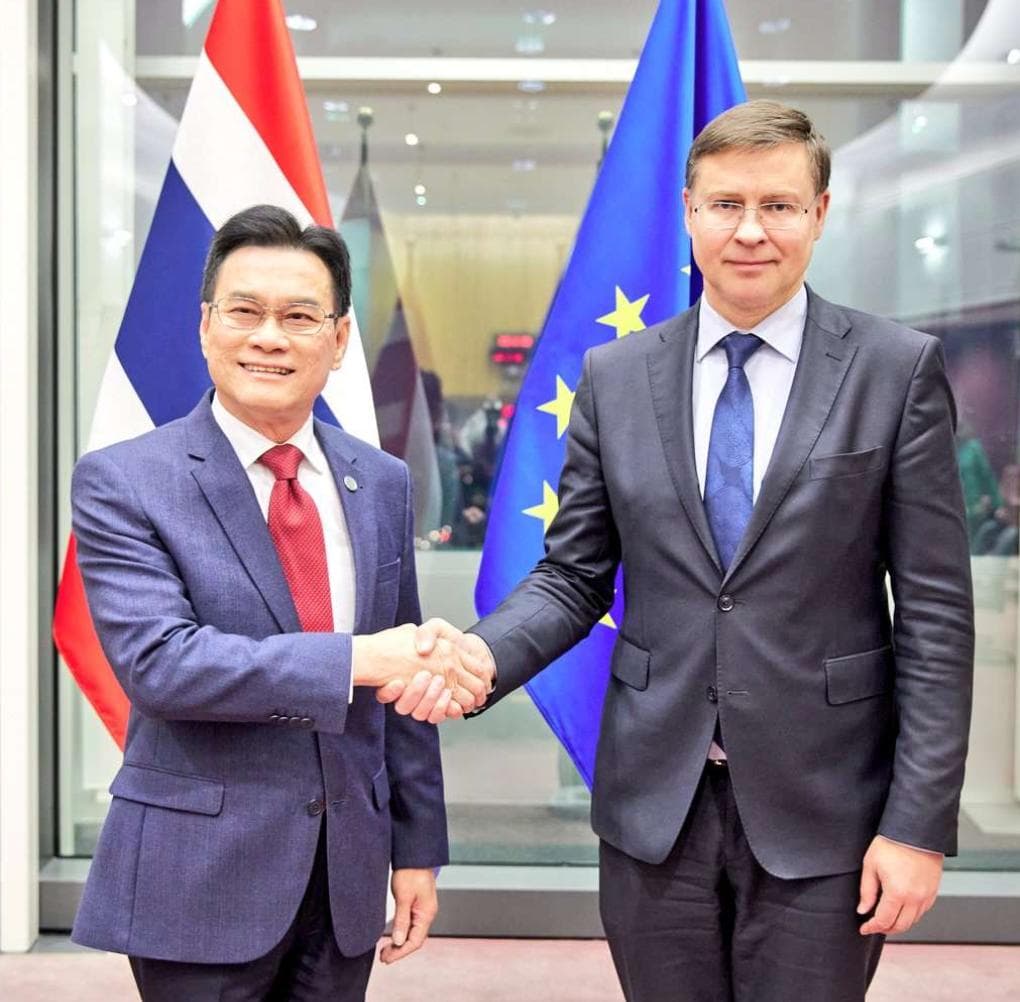
Bangkok: The Thailand trade file, once among the slowest in Europe’s crowded negotiating schedule, has suddenly become one of its most advanced. Negotiators wrapped their ninth round in Brussels at the end of June, and both governments now say they have settled roughly two-thirds of a sweeping agreement that could redraw how European exporters reach Southeast Asia.

The European Commission and Thailand confirmed that fifteen of the deal’s twenty-four chapters are complete. The latest round closed four more, covering competition and subsidies, state-owned enterprises, dispute settlement, and the institutional machinery that will police the pact once it enters force.

That progress matters because the two sides tried, and failed, to strike a deal a decade ago. Talks stalled after Thailand’s 2014 military coup, and Brussels froze contact for years. The current negotiation, relaunched in 2023, has moved with unusual speed precisely because both capitals now read the same map. Washington’s tariff turn has pushed exporters everywhere to hunt for steadier partners.

For Thailand, Europe offers a market of 450 million consumers and a chance to climb the value chain beyond electronics assembly and farm exports. Bangkok wants tariff relief for its cars, processed food, and gems, and it wants European investment in the semiconductor and clean-energy plants it hopes to host.

For the European Union, Thailand anchors a wider push into a region it long treated as an afterthought. The bloc has already sealed pacts with Singapore, Vietnam, and New Zealand, and it is chasing deals with Indonesia and the Philippines. A Thai agreement would knit those threads into something closer to a coherent Asian strategy rather than a scatter of bilateral wins.

The hard part still lies ahead. Negotiators have parked the market-opening offers, the numbers that decide which farmers and manufacturers actually gain, for the final rounds. Thai officials guard their car industry and their rice growers, while European capitals worry about cheap poultry and about sustainability rules that Bangkok considers intrusive.

Labour and environmental commitments loom largest. Brussels wants enforceable chapters on deforestation, fishing, and workers’ rights, and it has learned from the Mercosur backlash that vague promises no longer satisfy European parliaments. Thailand resents being lectured and insists any obligations must respect its own pace of reform.

Both sides have set an ambitious target of finishing before the end of 2026, with the tenth round due in Thailand in late September. Trade officials rarely meet such deadlines cleanly, and a single contested chapter can stall a deal for months.

Still, the direction of travel looks unmistakable. A finished pact would give European firms preferential access to the second-largest economy in Southeast Asia, and it would hand Thailand a hedge against its heavy reliance on China and the United States. In a fractured trading world, that mutual insurance may prove more persuasive than any single tariff line.