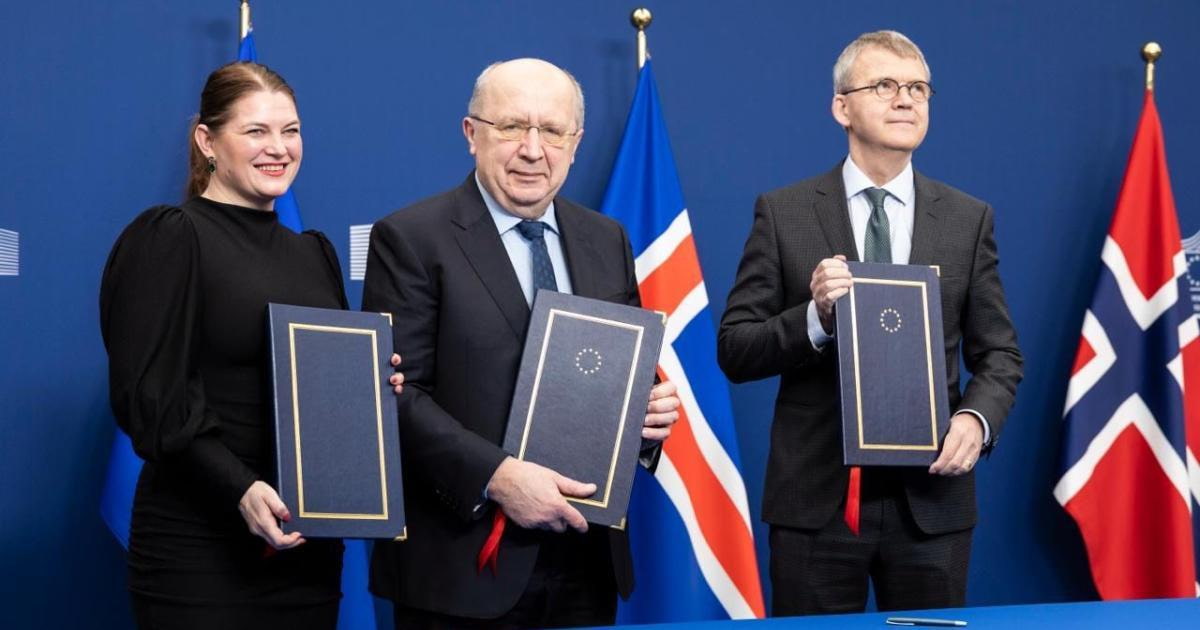
Brussels: Europe’s secure satellite networks are quietly gaining two members that sit far outside its borders but squarely inside its security perimeter. Norway and Iceland are joining GOVSATCOM and IRIS2, the EU’s governmental and secure connectivity programmes, and the legislative plumbing that formalises their role moved through the European Parliament this month.
The politics arrived before the paperwork. The EU signed the participation agreement on 26 March 2026, with Defence and Space Commissioner Andrius Kubilius representing the Union. Parliament’s industry committee has since worked through the rules that let two non-member states plug into systems designed for encrypted government traffic.
Why two small nations matter to EU space policy
Geography is the answer. Norway and Iceland command the northern approaches to Europe, the Arctic sea lanes and the airspace where NATO and Russian activity increasingly overlap. GOVSATCOM, which became operational in January 2026, pools secure satellite capacity for crisis management, disaster response and government communications. Extending it to Oslo and Reykjavik closes a gap on the map that Brussels cannot cover from the continent alone.
The benefits run both ways. The two countries gain access to high-tier encrypted communications they could not build alone, plus better connectivity for remote regions where satellite links now underpin everything from healthcare to environmental monitoring. The Union gains reach, redundancy and two capable partners in a theatre where secure bandwidth is becoming a strategic asset rather than a technical convenience.
The precedent and its limits
The deeper significance is the template. GOVSATCOM and IRIS2 were designed as instruments of European sovereignty, systems the EU could control without depending on American or commercial constellations. Letting non-members in complicates that story, because sovereignty and openness pull in opposite directions once encrypted government channels are shared.
The EU has managed the tension by keeping Norway and Iceland close on almost every other file. Both belong to the European Economic Area and Schengen, and both align routinely with EU foreign policy. If any outside states were going to be trusted with secure space assets, these two were the obvious candidates. That makes the agreement less a broad opening than a carefully bounded exception.
Still, the questions it raises will not stay bounded. Other partners, from the Western Balkans to Switzerland, will note that participation is possible and ask why it stops at the Nordic edge. Each future request will force Brussels to weigh the value of a wider secure network against the risk of diluting control over it. The Norway and Iceland deal answers that question once; it does not settle it.
For now, the EU has done something rare in space policy, which is to move quickly. A programme that only turned operational in January has already extended its footprint north within six months. In a domain where hardware takes years and treaties take longer, that speed is the real signal.