Geneva: For two decades the international campaign to isolate North Korea rested on a simple premise, that a country cut off from trade, finance and weapons markets would eventually be forced to bargain. Russia’s war in Ukraine has quietly dismantled that premise, and the European Union is now confronting a sanctions regime that remains formally intact but is losing its grip on reality.
The European Union maintains one of the most restrictive sanctions frameworks anywhere, built up in response to Pyongyang’s nuclear and ballistic missile programmes. Asset freezes, travel bans and sweeping trade prohibitions target individuals and entities tied to the regime’s weapons work and, increasingly, to its dealings with Moscow. The most recent expansion came in 2024, when the bloc added individuals and entities involved in sanctions evasion and in channelling support to Russia’s war effort.
The problem is not the design of the measures but the ground beneath them. By the end of 2025, North Korea had sent four separate troop deployments to Russia, amounting to roughly twenty-one thousand personnel, while sanctioned vessels are estimated to have moved between eight and eleven million rounds of ammunition from the country to Russian forces since mid-2023. In exchange, Pyongyang receives hard currency, food, energy and, according to Western officials, technical help for the very missile programmes the sanctions were meant to strangle. A regime that once had almost nothing to sell has found a desperate and well-resourced customer.
That transaction hollows out the logic of isolation. Sanctions work by denying a target access to markets, but North Korea no longer needs the markets Europe controls when Russia is willing to pay above any price for artillery shells and soldiers. The asymmetry leaves Brussels with instruments that still bite at the margins, freezing assets and naming front companies, while the central flow of money and materiel runs through a channel that European measures cannot easily reach.
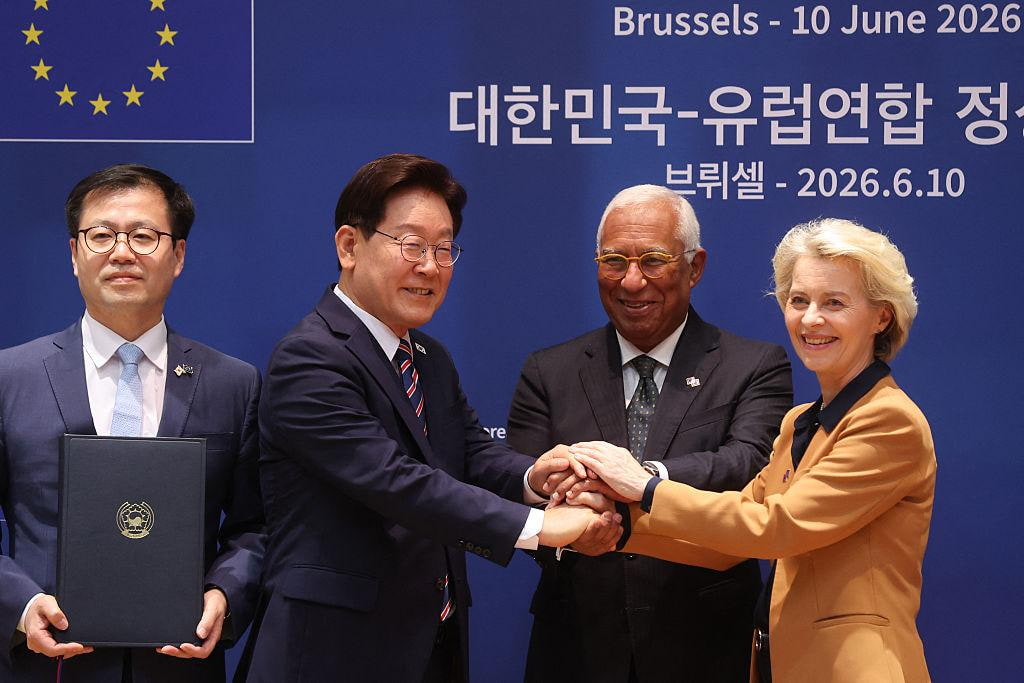
The diplomatic response has sharpened even as the practical leverage has thinned. At their summit on 10 June, the European Union and South Korea condemned the military cooperation between Moscow and Pyongyang in unusually direct language and restated that North Korea will never be accepted as a nuclear-weapon state, urging all United Nations members to enforce existing sanctions. The statement matters as a signal of resolve, but it also underlines how much the enforcement now depends on the goodwill of governments far beyond Europe’s reach.
For the European Union, the episode is a lesson in the limits of economic statecraft. Sanctions remain a necessary tool, both to deny resources at the edges and to make plain which conduct the bloc regards as intolerable. But they were built for a world in which great powers broadly agreed that proliferation should be contained. That consensus has fractured, and a permanent member of the Security Council is now actively underwriting the very behaviour the measures were meant to punish.
The realistic task ahead is narrower than the rhetoric suggests. Europe can tighten enforcement against the shipping networks and financial intermediaries that move North Korean goods, coordinate more closely with Seoul, Tokyo and Washington, and keep the diplomatic cost of cooperation high. What it cannot do alone is restore the leverage that the war has stripped away. The sanctions wall still stands, but everyone can see the gap that Russia has opened in it.