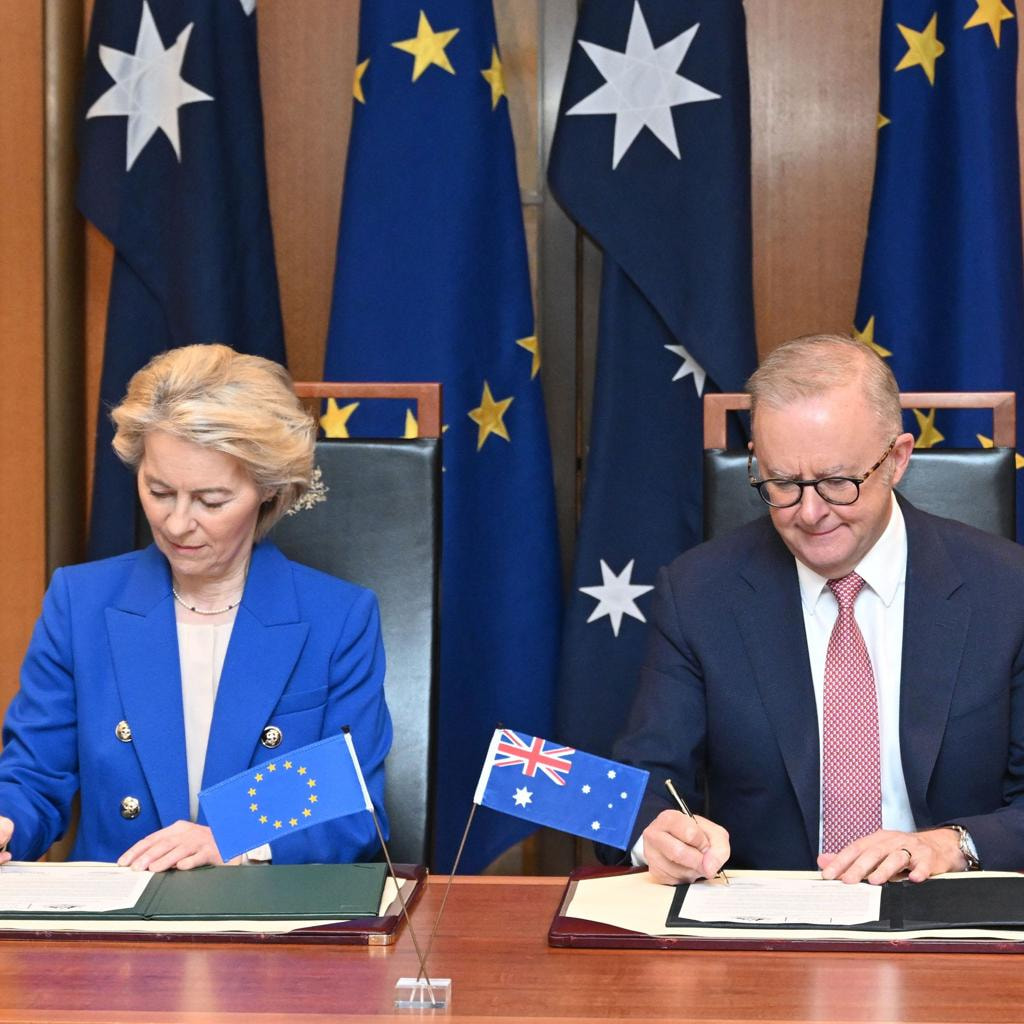
Wellington: Just over a year after it entered into force, the free trade agreement between the European Union and New Zealand has settled into the unglamorous business of actually working, which in trade policy is the highest form of praise. Signed in Brussels in July 2023 and in force since May 2024, the deal was always as much a statement of strategic intent as a commercial document, and the early returns suggest both dimensions are holding.
The economics were never going to reshape either economy on their own. New Zealand is a market of five million people at the far end of the world, and its trade with the Union is modest beside the bloc’s exchanges with China or the United States. Yet the projected gains are real on their own terms. The Commission’s impact assessment anticipated bilateral trade rising by around 30 percent, the elimination of customs duties saving European businesses some 140 million euros a year, and EU investment flows into New Zealand climbing by more than 80 percent. For exporters of machinery, chemicals and processed goods, the removal of long-standing duties is a tangible advantage.
What makes the agreement notable is less the tariff schedule than what it signals. New Zealand is a small, open, rule-following democracy in a region the EU has declared central to its future, and the deal cements a partnership with a genuinely like-minded state in the Indo-Pacific. At a moment when larger trade negotiations stall over agriculture, cars or geopolitics, a clean agreement with a trusted partner offers Brussels a rare example of its trade machinery delivering as designed.
The pact also carried features the Union now wants to make standard. It removed duties on all European goods entering New Zealand from day one, while phasing the EU’s own reductions on sensitive farm imports such as beef and dairy, a structure meant to reassure European farmers wary of antipodean competition. It bound both sides to commitments on labour rights, climate and sustainable development, the first time the Union attached enforceable sustainability provisions of this kind to a trade deal. Whether those clauses prove meaningful or symbolic will be watched closely by negotiators working on tougher agreements elsewhere.
For New Zealand, the calculation is partly about insurance. A country heavily exposed to Chinese demand has clear reasons to deepen ties with another large, stable market, and the agreement gives Wellington a hedge against the volatility of its biggest trading relationship. For the Union, the relationship is a foothold and a proof of concept, evidence that its Indo-Pacific strategy can amount to more than communiques.
The harder test comes next. Trade agreements deliver their benefits slowly, as firms adjust supply chains and discover new customers, and the headline projections will only be vindicated over years of patient use. A year in, the more reliable verdict is that the deal has done what it promised without drama or dispute. In an anxious era for global trade, an agreement that simply functions may be the most quietly persuasive argument the Union has.