August 29, 2026
LATEST
What Europe Needs From the GCC Summit Riyadh Will Host in AutumnHolding Limits Still Block a Digital Euro Deal Before DecemberData Rules Agreed With Seoul Now Wait on Parliament’s ConsentChina Listed Fourteen European Firms and November Ends the TruceWhy Australia’s Finished Trade Deal Still Has No Signature DateLate Application Leaves Tokyo Outside the Defence Loan QueueCyber Resilience Rules Give Makers 24 Hours From SeptemberWinter Stocks Test Europe’s New Gas Storage Flexibility RulesInnovation Theory Meets Merger Control in a New Commission StudyMercosur Tariffs Fell in May and the Court Has Not Ruled YetBilaterals III Now Turns on Which Referendum Switzerland PicksDark Patterns Face the EU Digital Fairness ActFifteen Chapters Stand Between Montenegro and 2028Who Blinks First in the FP10 Research Budget FightCustoms Reform Landed in March and Its Data Hub Opens in 2028Victims Rights Gain an EU Helpline and Capitals Have Two YearsIreland Must Move the EU Budget Box Before the October SummitFertiliser Prices Sit 71 Percent Above Their 2024 Average LevelState Aid Exemptions Face a Rewrite With Four Months to SpareIrregular Crossings Fell 37 Percent and Spain Is the ExceptionWhat Europe Needs From the GCC Summit Riyadh Will Host in AutumnHolding Limits Still Block a Digital Euro Deal Before DecemberData Rules Agreed With Seoul Now Wait on Parliament’s ConsentChina Listed Fourteen European Firms and November Ends the TruceWhy Australia’s Finished Trade Deal Still Has No Signature DateLate Application Leaves Tokyo Outside the Defence Loan QueueCyber Resilience Rules Give Makers 24 Hours From SeptemberWinter Stocks Test Europe’s New Gas Storage Flexibility RulesInnovation Theory Meets Merger Control in a New Commission StudyMercosur Tariffs Fell in May and the Court Has Not Ruled YetBilaterals III Now Turns on Which Referendum Switzerland PicksDark Patterns Face the EU Digital Fairness ActFifteen Chapters Stand Between Montenegro and 2028Who Blinks First in the FP10 Research Budget FightCustoms Reform Landed in March and Its Data Hub Opens in 2028Victims Rights Gain an EU Helpline and Capitals Have Two YearsIreland Must Move the EU Budget Box Before the October SummitFertiliser Prices Sit 71 Percent Above Their 2024 Average LevelState Aid Exemptions Face a Rewrite With Four Months to SpareIrregular Crossings Fell 37 Percent and Spain Is the Exception
August 29, 2026
LATEST
What Europe Needs From the GCC Summit Riyadh Will Host in AutumnHolding Limits Still Block a Digital Euro Deal Before DecemberData Rules Agreed With Seoul Now Wait on Parliament’s ConsentChina Listed Fourteen European Firms and November Ends the TruceWhy Australia’s Finished Trade Deal Still Has No Signature DateLate Application Leaves Tokyo Outside the Defence Loan QueueCyber Resilience Rules Give Makers 24 Hours From SeptemberWinter Stocks Test Europe’s New Gas Storage Flexibility RulesInnovation Theory Meets Merger Control in a New Commission StudyMercosur Tariffs Fell in May and the Court Has Not Ruled YetBilaterals III Now Turns on Which Referendum Switzerland PicksDark Patterns Face the EU Digital Fairness ActFifteen Chapters Stand Between Montenegro and 2028Who Blinks First in the FP10 Research Budget FightCustoms Reform Landed in March and Its Data Hub Opens in 2028Victims Rights Gain an EU Helpline and Capitals Have Two YearsIreland Must Move the EU Budget Box Before the October SummitFertiliser Prices Sit 71 Percent Above Their 2024 Average LevelState Aid Exemptions Face a Rewrite With Four Months to SpareIrregular Crossings Fell 37 Percent and Spain Is the ExceptionWhat Europe Needs From the GCC Summit Riyadh Will Host in AutumnHolding Limits Still Block a Digital Euro Deal Before DecemberData Rules Agreed With Seoul Now Wait on Parliament’s ConsentChina Listed Fourteen European Firms and November Ends the TruceWhy Australia’s Finished Trade Deal Still Has No Signature DateLate Application Leaves Tokyo Outside the Defence Loan QueueCyber Resilience Rules Give Makers 24 Hours From SeptemberWinter Stocks Test Europe’s New Gas Storage Flexibility RulesInnovation Theory Meets Merger Control in a New Commission StudyMercosur Tariffs Fell in May and the Court Has Not Ruled YetBilaterals III Now Turns on Which Referendum Switzerland PicksDark Patterns Face the EU Digital Fairness ActFifteen Chapters Stand Between Montenegro and 2028Who Blinks First in the FP10 Research Budget FightCustoms Reform Landed in March and Its Data Hub Opens in 2028Victims Rights Gain an EU Helpline and Capitals Have Two YearsIreland Must Move the EU Budget Box Before the October SummitFertiliser Prices Sit 71 Percent Above Their 2024 Average LevelState Aid Exemptions Face a Rewrite With Four Months to SpareIrregular Crossings Fell 37 Percent and Spain Is the Exception

Half of Europe Sits Under Drought and the Rivers Show It

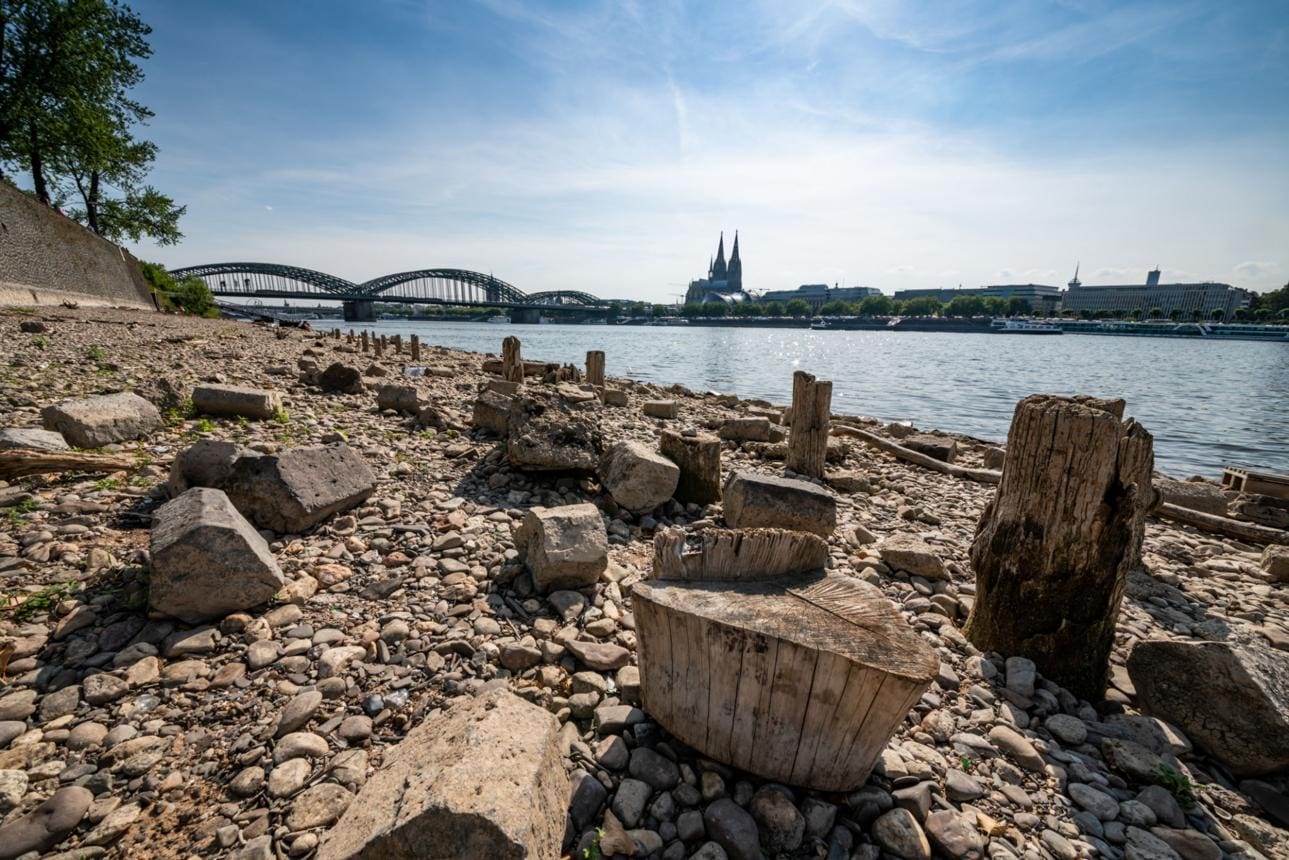
Cologne: The Rhine fell to 74 centimetres here in July, and the gauge has barely recovered since. Sandbanks that spend most of the year underwater now sit exposed along stretches of the Loire, the Po, the Rhine and the Danube. Copernicus Sentinel-2 passed over all four rivers between 1 and 3 August and returned images of gravel bars and braided channels where navigation lanes belong.

The Joint Research Centre put numbers behind those pictures on 12 August. Half of the European Union and the United Kingdom sat under some level of drought during July, with 9 per cent of the territory at the most severe alert stage. The European drought that analysts flagged as a warning signal in May hardened through two of the hottest months on record.

Four rivers, four different failures

Low water does not damage every sector the same way, and that is what makes this summer analytically interesting. The Rhine functions as an industrial artery. Barges that normally carry coal, chemicals and grain into Germany and Switzerland load at partial capacity when draught limits bite, so freight costs climb per tonne and inland supply chains absorb the difference.

The Danube fails differently. Navigation stalls in Hungary and Romania, but the sharper problem runs through water supply and irrigation for farms that draw from the main channel and its tributaries. The Po basin repeats that pattern in Italy, where irrigation, hydroelectric output and freshwater availability all compete for the same shrinking volume.

Energy sits underneath all of it. Reduced flows cut hydropower generation directly, and they constrain thermal and nuclear plants that rely on river water for cooling. A river at record lows therefore removes generation capacity in exactly the weeks when cooling demand peaks. The European drought becomes an electricity story without anyone legislating it into one.

What the fire data adds

Heat and rainfall deficit fed a second outcome. The European Forest Fire Information System counted 568,415 hectares burnt across the Union from 1,647 fires by 13 August. The twenty-year average for early August sits near 197,347 hectares. Spain absorbed roughly 38 per cent of the Union total by early August, with about 185,948 hectares, and France followed at roughly 99,092 hectares, or a fifth.

Those figures deserve careful handling. The 2026 season runs behind 2025 on the same calendar date once mid-August comparisons enter the picture, and it ranks fourth in cumulative burnt area at week 31 behind 2012, 2022 and 2017. The honest reading is not that 2026 broke every record. It is that a season this large has now occurred four times in fourteen years, which turns an outlier into a distribution.

Two member states also account for most of the burnt area. That concentration matters for civil protection planning, because it means the rescEU aerial fleet and pre-positioned firefighting teams face predictable demand geography rather than a Union-wide lottery.

The European Water Resilience Strategy, adopted on 4 June 2025, lists more than fifty actions and leans on a sponge facility meant to restore the capacity of landscapes to hold water and release it slowly. Member states have prioritised around 3.1 billion euros under it so far. The instrument targets the right variable, since retention upstream reduces both flood peaks and summer scarcity, but restored wetlands and reconnected floodplains deliver measurable storage over a decade, not a season.

That timing gap is the core finding. Europe now runs an observation system that describes drought in near real time alongside a policy framework that operates on ecological timescales. The monitoring works. The August assessment arrived while the rivers were still falling. What remains missing is any mechanism that converts a drought alert into binding limits on abstraction before a basin empties, which leaves allocation decisions to national authorities improvising under pressure.

Sceptics of stronger Union rules make a reasonable case. Water allocation depends on catchment hydrology, crop mix and local infrastructure, and Brussels holds no comparative advantage in judging when a Spanish reservoir should stop serving irrigators. The counterpoint is that four transboundary rivers reached record lows at once, and unilateral abstraction upstream pushes scarcity downstream across borders. Coordination failures of that shape are precisely what Union law usually exists to correct.