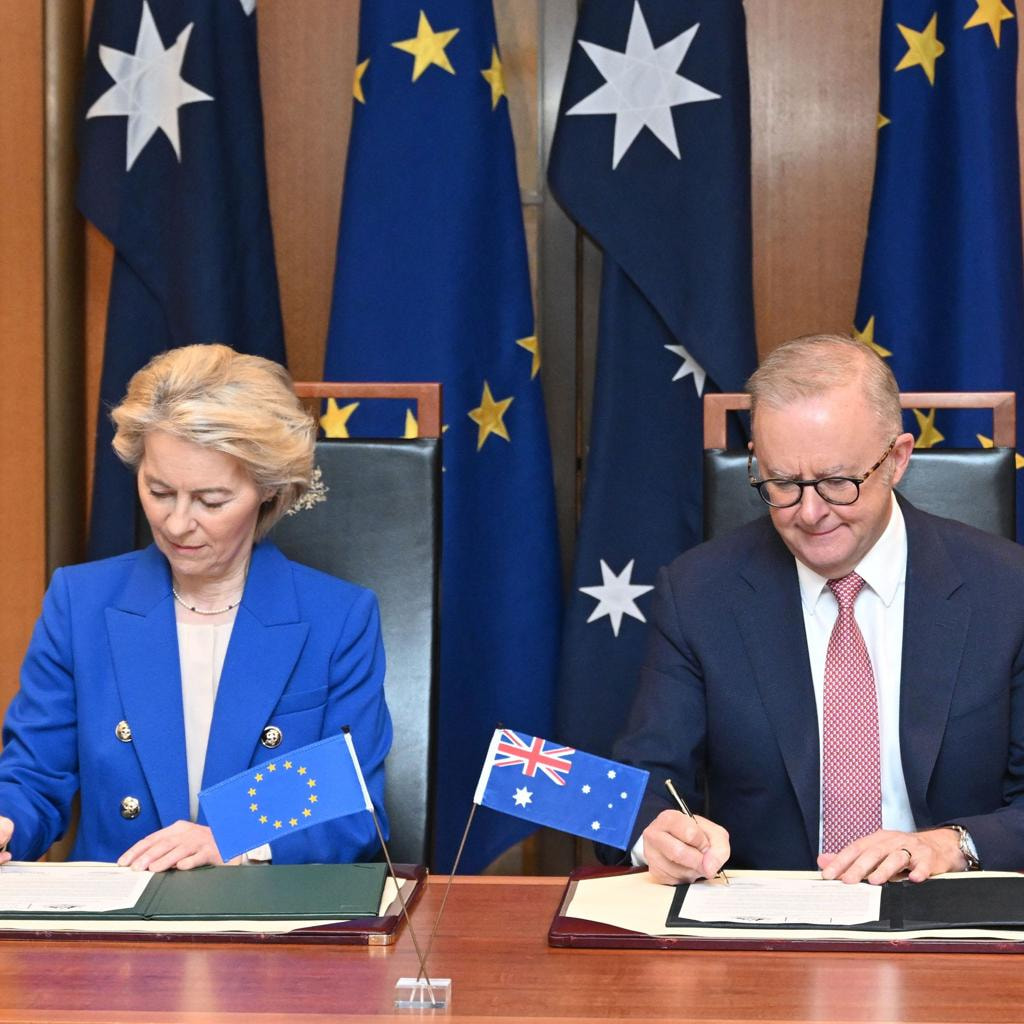
Canberra: After almost eight years of talks that collapsed once and had to be revived, Australia and the European Union finally signed a free-trade agreement in the Australian capital on 24 March 2026. The timing was no accident. Both partners have spent the past year watching the United States reach for tariffs as an instrument of first resort, and both concluded that the safest hedge against that volatility was a firmer commitment to each other. A deal that had languished over European farm protections and Australian beef quotas suddenly looked less like a technical negotiation and more like insurance.
The economics are substantial without being revolutionary. The European Union will scrap around 98 percent of its duties on Australian exports, opening its market wider to Australian wine, dairy, wheat, barley and seafood. In return Canberra will lift more than 99 percent of its tariffs on European goods, with dairy, motor vehicles and chemicals the obvious beneficiaries. Australian officials put the value to their own economy at roughly ten billion Australian dollars a year, a figure that flatters the deal slightly but points in the right direction. For European exporters, the prize is a wealthy, English-speaking market that has until now leaned heavily on Asian trade routes.
The strategic core of the agreement, however, lies underground. The text removes almost all tariffs on Australian critical-mineral exports and wraps them in sustainability compliance rules that European industry has been demanding for years. Aluminium, lithium and manganese are the headline commodities, each essential to the batteries, grids and defence hardware that Europe wants to build without depending on a single dominant supplier. Australia, blessed with the geology and cursed with the distance, gets a reliable buyer; Europe gets raw material from a stable democracy rather than from a rival.
It would be a mistake to oversell what this changes in the short term. Australia mines a great deal but processes comparatively little, and the refining of most critical minerals still runs through China. A tariff line in a treaty does not by itself build a smelter or a separation plant, and analysts in both countries have been quick to caution that supply-chain independence remains years and many billions of investment away. The agreement lowers the barriers to that investment; it does not conjure it into being.
Nor is the deal home yet. It must still clear the European Parliament and the member states, where farm lobbies that fought the concessions on agriculture will scrutinise every clause, and where the memory of the last collapse still lingers. Yet the direction of travel is clear. Two comfortable middle powers, each nervous about the reliability of larger partners, have decided that binding themselves together is worth the compromises it demands. In a trading system that has grown noticeably colder, that is a warmer outcome than either could have managed alone, and a reminder that the quiet business of writing rules still counts for something.