August 10, 2026
LATEST
Five Joint Defence Projects Launch Europe’s Military ShieldElectrification Plan Aims to Make Europe First Electro ContinentHorizon Europe Budget Fight Heats Up as Ministers Push BackGoogle’s DMA Fine Sets Off a Transatlantic Tariff ClashTwenty New University Alliances Join Erasmus for Two YearsForeign Subsidies Case Puts Temu in the EU’s SightsVan Tachographs Now Mandatory for Cross-Border FleetsStress Test Exposes Gaps in Euro Area Bank DefencesEurope Bets on a Gulf Partnership Before the Riyadh SummitWhy the Atlantic Route Now Runs Through MauritaniaKyiv and Chisinau Advance as the EU Accession Talks Gather PaceEurope’s New Digital Border System Beds In After a Rocky RolloutBrussels Mounts Its Largest Wildfire Response as the Fires SpreadRetail Spending Slipped in June, Wrong-Footing EconomistsHeatwave Warning Puts Brussels on Alert for Vulnerable GroupsKANAL’s 230 Million Euro Museum Sets a November Opening DatePension Savings Rules Get a Reset as the EU Scraps the 1% CapMedicine Shortages Move to the Heart of Europe’s Pharma ResetJapan Becomes Europe’s Closest Security Partner in AsiaCan Europe’s New Zealand Deal Anchor It in the Pacific?Five Joint Defence Projects Launch Europe’s Military ShieldElectrification Plan Aims to Make Europe First Electro ContinentHorizon Europe Budget Fight Heats Up as Ministers Push BackGoogle’s DMA Fine Sets Off a Transatlantic Tariff ClashTwenty New University Alliances Join Erasmus for Two YearsForeign Subsidies Case Puts Temu in the EU’s SightsVan Tachographs Now Mandatory for Cross-Border FleetsStress Test Exposes Gaps in Euro Area Bank DefencesEurope Bets on a Gulf Partnership Before the Riyadh SummitWhy the Atlantic Route Now Runs Through MauritaniaKyiv and Chisinau Advance as the EU Accession Talks Gather PaceEurope’s New Digital Border System Beds In After a Rocky RolloutBrussels Mounts Its Largest Wildfire Response as the Fires SpreadRetail Spending Slipped in June, Wrong-Footing EconomistsHeatwave Warning Puts Brussels on Alert for Vulnerable GroupsKANAL’s 230 Million Euro Museum Sets a November Opening DatePension Savings Rules Get a Reset as the EU Scraps the 1% CapMedicine Shortages Move to the Heart of Europe’s Pharma ResetJapan Becomes Europe’s Closest Security Partner in AsiaCan Europe’s New Zealand Deal Anchor It in the Pacific?
August 10, 2026
LATEST
Five Joint Defence Projects Launch Europe’s Military ShieldElectrification Plan Aims to Make Europe First Electro ContinentHorizon Europe Budget Fight Heats Up as Ministers Push BackGoogle’s DMA Fine Sets Off a Transatlantic Tariff ClashTwenty New University Alliances Join Erasmus for Two YearsForeign Subsidies Case Puts Temu in the EU’s SightsVan Tachographs Now Mandatory for Cross-Border FleetsStress Test Exposes Gaps in Euro Area Bank DefencesEurope Bets on a Gulf Partnership Before the Riyadh SummitWhy the Atlantic Route Now Runs Through MauritaniaKyiv and Chisinau Advance as the EU Accession Talks Gather PaceEurope’s New Digital Border System Beds In After a Rocky RolloutBrussels Mounts Its Largest Wildfire Response as the Fires SpreadRetail Spending Slipped in June, Wrong-Footing EconomistsHeatwave Warning Puts Brussels on Alert for Vulnerable GroupsKANAL’s 230 Million Euro Museum Sets a November Opening DatePension Savings Rules Get a Reset as the EU Scraps the 1% CapMedicine Shortages Move to the Heart of Europe’s Pharma ResetJapan Becomes Europe’s Closest Security Partner in AsiaCan Europe’s New Zealand Deal Anchor It in the Pacific?Five Joint Defence Projects Launch Europe’s Military ShieldElectrification Plan Aims to Make Europe First Electro ContinentHorizon Europe Budget Fight Heats Up as Ministers Push BackGoogle’s DMA Fine Sets Off a Transatlantic Tariff ClashTwenty New University Alliances Join Erasmus for Two YearsForeign Subsidies Case Puts Temu in the EU’s SightsVan Tachographs Now Mandatory for Cross-Border FleetsStress Test Exposes Gaps in Euro Area Bank DefencesEurope Bets on a Gulf Partnership Before the Riyadh SummitWhy the Atlantic Route Now Runs Through MauritaniaKyiv and Chisinau Advance as the EU Accession Talks Gather PaceEurope’s New Digital Border System Beds In After a Rocky RolloutBrussels Mounts Its Largest Wildfire Response as the Fires SpreadRetail Spending Slipped in June, Wrong-Footing EconomistsHeatwave Warning Puts Brussels on Alert for Vulnerable GroupsKANAL’s 230 Million Euro Museum Sets a November Opening DatePension Savings Rules Get a Reset as the EU Scraps the 1% CapMedicine Shortages Move to the Heart of Europe’s Pharma ResetJapan Becomes Europe’s Closest Security Partner in AsiaCan Europe’s New Zealand Deal Anchor It in the Pacific?

Vietnam Becomes Europe’s Test Case for an ASEAN Trade Deal

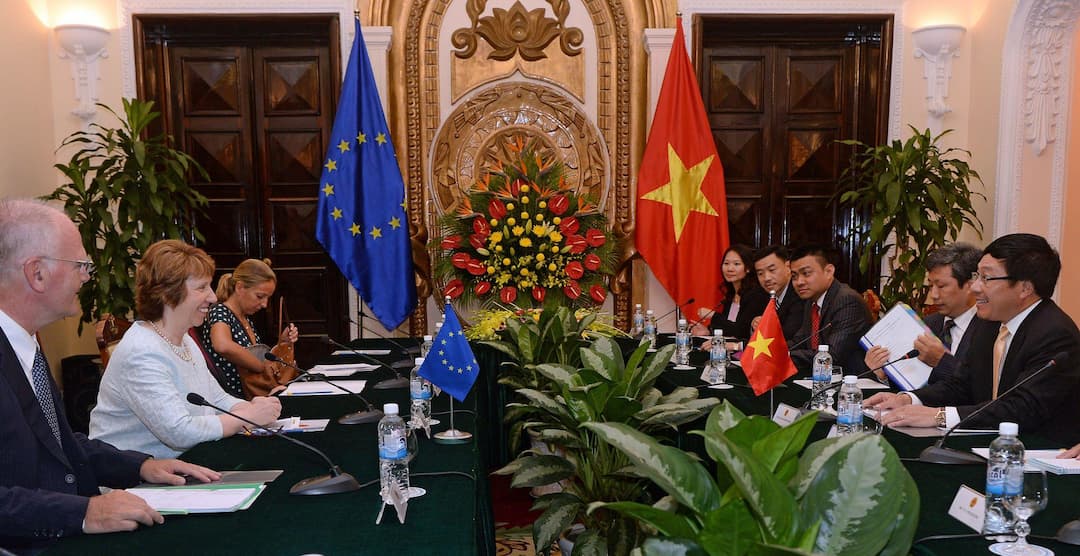
Hanoi: The decision to elevate relations with the European Union to a Comprehensive Strategic Partnership, the highest rung in Vietnam’s diplomatic hierarchy, is being read in Brussels less as a bilateral milestone than as a rehearsal. For more than a decade the EU has talked about a region-to-region trade pact with the Association of Southeast Asian Nations, only to watch the ambition founder on the bloc’s internal diversity. Vietnam, already the EU’s largest goods-trade partner in Southeast Asia, is where Europe is quietly testing whether that older dream can be revived one country at a time.

The foundations are not new. The EU-Vietnam Free Trade Agreement entered into force in August 2020 and has steadily dismantled tariffs across a wide span of goods, turning Vietnam into a hub for European exporters and a manufacturing alternative for firms trimming their exposure to China. What is new is the political framing. By layering a strategic partnership on top of an existing trade deal, both sides are signalling that the relationship is now about supply-chain resilience, digital rules and geopolitical hedging rather than market access alone.

Digital trade is the clearest tell. Hanoi has placed cross-border data flows, cybersecurity standards and a maturing personal data protection regime near the centre of its external economic policy. Those are precisely the chapters that have proved hardest to close in EU negotiations with larger Asian economies, and getting them right with Vietnam would give Brussels a template it could carry into wider ASEAN talks. The unspoken comparison is with the patient, sector-by-sector approach that eventually produced agreements with Japan and Singapore.

The strategy is not without risk. ASEAN’s members range from high-income Singapore to economies with weak labour and environmental enforcement, and a deal that works for Vietnam may not generalise. European lawmakers have grown more insistent that trade preferences be tied to sustainability commitments, a demand that complicates any fast-track to a bloc-wide pact. There is also the awkward reality that Vietnam, like much of the region, is reluctant to be cast as a pawn in a contest between Washington, Brussels and Beijing, and will resist language that reads as choosing sides.

Skeptics in Brussels argue that bilateral upgrades are a poor substitute for the genuine region-to-region agreement that would give European firms predictable rules across the whole of Southeast Asia. They have a point: a patchwork of national deals can entrench fragmentation as easily as it builds momentum. Yet the alternative, waiting for ten capitals to agree at once, has already cost Europe a decade of lost ground to more nimble competitors.

For now the calculation is pragmatic. Each closed chapter with Hanoi narrows the gap between aspiration and architecture, and gives officials a working draft to put in front of the next willing partner. Whether Vietnam proves to be a bridge to ASEAN or merely a well-managed exception will not be clear for years. But Europe has decided that the surest way to test the proposition is to build the deal it can reach, and let the region draw its own conclusions.