August 10, 2026
LATEST
After Nine Years, Europe and Australia Seal a Trade PactBeijing Answers Europe’s Russia Sanctions in KindOne Year On, the EU-Japan Alliance Faces Its First TestEurope’s Chip Ambitions Still Run Through Taiwan’s FabsWhy South Korea Bet Its Research Future on Europe’s ProgrammeEurope and Japan Deepen Their Economic Alliance as Rivals CircleFive Joint Defence Projects Launch Europe’s Military ShieldElectrification Plan Aims to Make Europe First Electro ContinentHorizon Europe Budget Fight Heats Up as Ministers Push BackGoogle’s DMA Fine Sets Off a Transatlantic Tariff ClashTwenty New University Alliances Join Erasmus for Two YearsForeign Subsidies Case Puts Temu in the EU’s SightsVan Tachographs Now Mandatory for Cross-Border FleetsStress Test Exposes Gaps in Euro Area Bank DefencesEurope Bets on a Gulf Partnership Before the Riyadh SummitWhy the Atlantic Route Now Runs Through MauritaniaKyiv and Chisinau Advance as the EU Accession Talks Gather PaceEurope’s New Digital Border System Beds In After a Rocky RolloutBrussels Mounts Its Largest Wildfire Response as the Fires SpreadRetail Spending Slipped in June, Wrong-Footing EconomistsAfter Nine Years, Europe and Australia Seal a Trade PactBeijing Answers Europe’s Russia Sanctions in KindOne Year On, the EU-Japan Alliance Faces Its First TestEurope’s Chip Ambitions Still Run Through Taiwan’s FabsWhy South Korea Bet Its Research Future on Europe’s ProgrammeEurope and Japan Deepen Their Economic Alliance as Rivals CircleFive Joint Defence Projects Launch Europe’s Military ShieldElectrification Plan Aims to Make Europe First Electro ContinentHorizon Europe Budget Fight Heats Up as Ministers Push BackGoogle’s DMA Fine Sets Off a Transatlantic Tariff ClashTwenty New University Alliances Join Erasmus for Two YearsForeign Subsidies Case Puts Temu in the EU’s SightsVan Tachographs Now Mandatory for Cross-Border FleetsStress Test Exposes Gaps in Euro Area Bank DefencesEurope Bets on a Gulf Partnership Before the Riyadh SummitWhy the Atlantic Route Now Runs Through MauritaniaKyiv and Chisinau Advance as the EU Accession Talks Gather PaceEurope’s New Digital Border System Beds In After a Rocky RolloutBrussels Mounts Its Largest Wildfire Response as the Fires SpreadRetail Spending Slipped in June, Wrong-Footing Economists
August 10, 2026
LATEST
After Nine Years, Europe and Australia Seal a Trade PactBeijing Answers Europe’s Russia Sanctions in KindOne Year On, the EU-Japan Alliance Faces Its First TestEurope’s Chip Ambitions Still Run Through Taiwan’s FabsWhy South Korea Bet Its Research Future on Europe’s ProgrammeEurope and Japan Deepen Their Economic Alliance as Rivals CircleFive Joint Defence Projects Launch Europe’s Military ShieldElectrification Plan Aims to Make Europe First Electro ContinentHorizon Europe Budget Fight Heats Up as Ministers Push BackGoogle’s DMA Fine Sets Off a Transatlantic Tariff ClashTwenty New University Alliances Join Erasmus for Two YearsForeign Subsidies Case Puts Temu in the EU’s SightsVan Tachographs Now Mandatory for Cross-Border FleetsStress Test Exposes Gaps in Euro Area Bank DefencesEurope Bets on a Gulf Partnership Before the Riyadh SummitWhy the Atlantic Route Now Runs Through MauritaniaKyiv and Chisinau Advance as the EU Accession Talks Gather PaceEurope’s New Digital Border System Beds In After a Rocky RolloutBrussels Mounts Its Largest Wildfire Response as the Fires SpreadRetail Spending Slipped in June, Wrong-Footing EconomistsAfter Nine Years, Europe and Australia Seal a Trade PactBeijing Answers Europe’s Russia Sanctions in KindOne Year On, the EU-Japan Alliance Faces Its First TestEurope’s Chip Ambitions Still Run Through Taiwan’s FabsWhy South Korea Bet Its Research Future on Europe’s ProgrammeEurope and Japan Deepen Their Economic Alliance as Rivals CircleFive Joint Defence Projects Launch Europe’s Military ShieldElectrification Plan Aims to Make Europe First Electro ContinentHorizon Europe Budget Fight Heats Up as Ministers Push BackGoogle’s DMA Fine Sets Off a Transatlantic Tariff ClashTwenty New University Alliances Join Erasmus for Two YearsForeign Subsidies Case Puts Temu in the EU’s SightsVan Tachographs Now Mandatory for Cross-Border FleetsStress Test Exposes Gaps in Euro Area Bank DefencesEurope Bets on a Gulf Partnership Before the Riyadh SummitWhy the Atlantic Route Now Runs Through MauritaniaKyiv and Chisinau Advance as the EU Accession Talks Gather PaceEurope’s New Digital Border System Beds In After a Rocky RolloutBrussels Mounts Its Largest Wildfire Response as the Fires SpreadRetail Spending Slipped in June, Wrong-Footing Economists

What The Australia Deal Reveals About Europe’s Risk Strategy

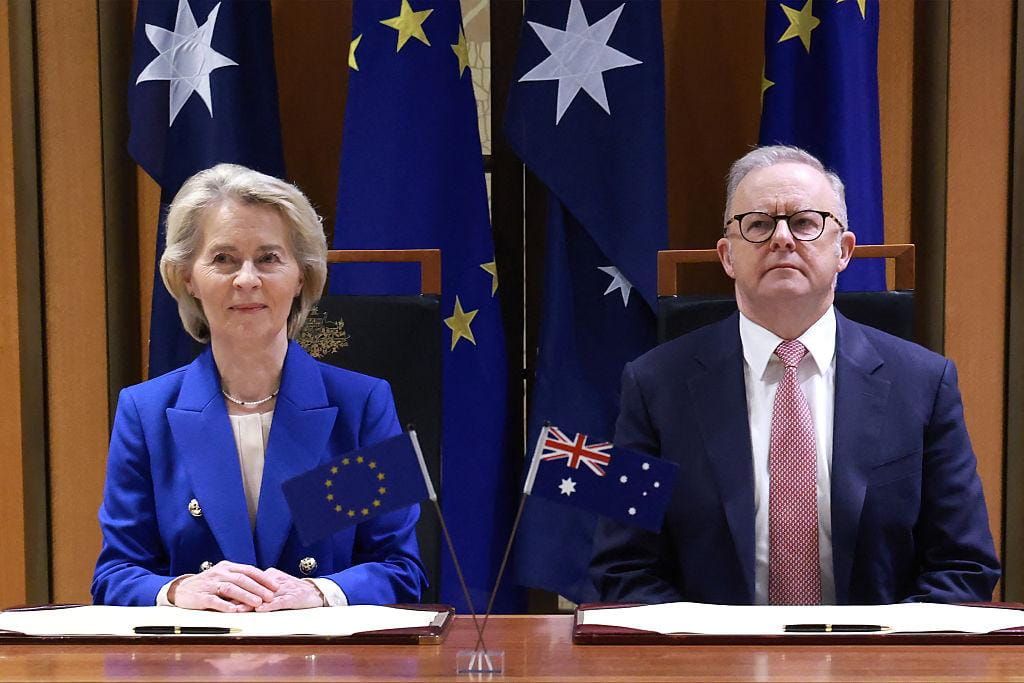
Canberra: When negotiators finally closed the European Union–Australia free trade agreement in late March, the headline figure — roughly ten billion Australian dollars in expected commercial value — was the least revealing part of the announcement. The more consequential signal sat in the companion document signed beside it: a Security and Defence Partnership tying Brussels and Canberra together on cyber threats, maritime security, space, hybrid warfare and defence-industrial cooperation. Trade ministries wrapped up a deal eight years in the making. Strategists, with far less fanfare, opened something larger.

The commercial case is solid. The agreement removes tariffs from more than ninety-nine percent of European exports to Australia, sparing EU firms on the order of a billion euros a year, while nearly all Australian manufactured goods and mineral resources will enter the single market duty-free. Yet the clauses likely to matter most over the coming decade concern critical raw materials. Lithium, manganese, aluminium and tungsten — the unglamorous inputs behind batteries, magnets and munitions — form the backbone of the deal’s economic-security architecture. Europe has spent three uneasy years learning how exposed it is to a single dominant supplier of processed minerals, and Australia offers something genuinely scarce: a like-minded democracy that happens to sit atop much of what the green and defence transitions demand.

What gives the Canberra package strategic coherence is the marriage of those two instruments. A trade pact alone would have been a worthy but conventional achievement; a defence partnership alone would have been symbolism without ballast. Together they signal that Europe now treats market access and security as a single problem. The economic-security chapter explicitly links critical-mineral supply to the partnership’s defence agenda, an acknowledgement that the line between an industrial input and a strategic asset has all but vanished.

The timing is no accident. Both partners are hedging against a more transactional Washington and a more assertive Beijing, and both have concluded that resilience is something you build with partners rather than purchase on open markets. For Australia, the deal diversifies an export base still heavily tilted toward a single buyer. For Europe, it plants a flag in the Indo-Pacific without the burden of a permanent military presence — influence by treaty rather than by fleet.

Sober observers will note the limits. Signing a mineral-supply commitment is not the same as standing up a mine, a refinery or a magnet plant, and the projects that would loosen China’s grip on processing take the better part of a decade to mature. Ratification across twenty-seven member states and the European Parliament remains a slow, occasionally hostile gauntlet, and Australian farmers extracted concessions that some European producers will resent. The defence partnership, for now, is a framework for dialogue rather than a mutual obligation.

None of that diminishes the strategic logic. The agreement is best read not as a single transaction but as a statement of intent — that two middle-sized democratic powers, oceans apart, have decided their futures are linked by supply chains and shared risk. Europe has spent the decade discovering that geography no longer dictates who its partners must be. Canberra, improbably, has become one of the more important answers to that question, and the months ahead will test whether the ambition on paper survives contact with the politics of delivery.