August 10, 2026
LATEST
Five Joint Defence Projects Launch Europe’s Military ShieldElectrification Plan Aims to Make Europe First Electro ContinentHorizon Europe Budget Fight Heats Up as Ministers Push BackGoogle’s DMA Fine Sets Off a Transatlantic Tariff ClashTwenty New University Alliances Join Erasmus for Two YearsForeign Subsidies Case Puts Temu in the EU’s SightsVan Tachographs Now Mandatory for Cross-Border FleetsStress Test Exposes Gaps in Euro Area Bank DefencesEurope Bets on a Gulf Partnership Before the Riyadh SummitWhy the Atlantic Route Now Runs Through MauritaniaKyiv and Chisinau Advance as the EU Accession Talks Gather PaceEurope’s New Digital Border System Beds In After a Rocky RolloutBrussels Mounts Its Largest Wildfire Response as the Fires SpreadRetail Spending Slipped in June, Wrong-Footing EconomistsHeatwave Warning Puts Brussels on Alert for Vulnerable GroupsKANAL’s 230 Million Euro Museum Sets a November Opening DatePension Savings Rules Get a Reset as the EU Scraps the 1% CapMedicine Shortages Move to the Heart of Europe’s Pharma ResetJapan Becomes Europe’s Closest Security Partner in AsiaCan Europe’s New Zealand Deal Anchor It in the Pacific?Five Joint Defence Projects Launch Europe’s Military ShieldElectrification Plan Aims to Make Europe First Electro ContinentHorizon Europe Budget Fight Heats Up as Ministers Push BackGoogle’s DMA Fine Sets Off a Transatlantic Tariff ClashTwenty New University Alliances Join Erasmus for Two YearsForeign Subsidies Case Puts Temu in the EU’s SightsVan Tachographs Now Mandatory for Cross-Border FleetsStress Test Exposes Gaps in Euro Area Bank DefencesEurope Bets on a Gulf Partnership Before the Riyadh SummitWhy the Atlantic Route Now Runs Through MauritaniaKyiv and Chisinau Advance as the EU Accession Talks Gather PaceEurope’s New Digital Border System Beds In After a Rocky RolloutBrussels Mounts Its Largest Wildfire Response as the Fires SpreadRetail Spending Slipped in June, Wrong-Footing EconomistsHeatwave Warning Puts Brussels on Alert for Vulnerable GroupsKANAL’s 230 Million Euro Museum Sets a November Opening DatePension Savings Rules Get a Reset as the EU Scraps the 1% CapMedicine Shortages Move to the Heart of Europe’s Pharma ResetJapan Becomes Europe’s Closest Security Partner in AsiaCan Europe’s New Zealand Deal Anchor It in the Pacific?
August 10, 2026
LATEST
Five Joint Defence Projects Launch Europe’s Military ShieldElectrification Plan Aims to Make Europe First Electro ContinentHorizon Europe Budget Fight Heats Up as Ministers Push BackGoogle’s DMA Fine Sets Off a Transatlantic Tariff ClashTwenty New University Alliances Join Erasmus for Two YearsForeign Subsidies Case Puts Temu in the EU’s SightsVan Tachographs Now Mandatory for Cross-Border FleetsStress Test Exposes Gaps in Euro Area Bank DefencesEurope Bets on a Gulf Partnership Before the Riyadh SummitWhy the Atlantic Route Now Runs Through MauritaniaKyiv and Chisinau Advance as the EU Accession Talks Gather PaceEurope’s New Digital Border System Beds In After a Rocky RolloutBrussels Mounts Its Largest Wildfire Response as the Fires SpreadRetail Spending Slipped in June, Wrong-Footing EconomistsHeatwave Warning Puts Brussels on Alert for Vulnerable GroupsKANAL’s 230 Million Euro Museum Sets a November Opening DatePension Savings Rules Get a Reset as the EU Scraps the 1% CapMedicine Shortages Move to the Heart of Europe’s Pharma ResetJapan Becomes Europe’s Closest Security Partner in AsiaCan Europe’s New Zealand Deal Anchor It in the Pacific?Five Joint Defence Projects Launch Europe’s Military ShieldElectrification Plan Aims to Make Europe First Electro ContinentHorizon Europe Budget Fight Heats Up as Ministers Push BackGoogle’s DMA Fine Sets Off a Transatlantic Tariff ClashTwenty New University Alliances Join Erasmus for Two YearsForeign Subsidies Case Puts Temu in the EU’s SightsVan Tachographs Now Mandatory for Cross-Border FleetsStress Test Exposes Gaps in Euro Area Bank DefencesEurope Bets on a Gulf Partnership Before the Riyadh SummitWhy the Atlantic Route Now Runs Through MauritaniaKyiv and Chisinau Advance as the EU Accession Talks Gather PaceEurope’s New Digital Border System Beds In After a Rocky RolloutBrussels Mounts Its Largest Wildfire Response as the Fires SpreadRetail Spending Slipped in June, Wrong-Footing EconomistsHeatwave Warning Puts Brussels on Alert for Vulnerable GroupsKANAL’s 230 Million Euro Museum Sets a November Opening DatePension Savings Rules Get a Reset as the EU Scraps the 1% CapMedicine Shortages Move to the Heart of Europe’s Pharma ResetJapan Becomes Europe’s Closest Security Partner in AsiaCan Europe’s New Zealand Deal Anchor It in the Pacific?

One Method Now Counts Every Tonne Transport Emits Across The EU

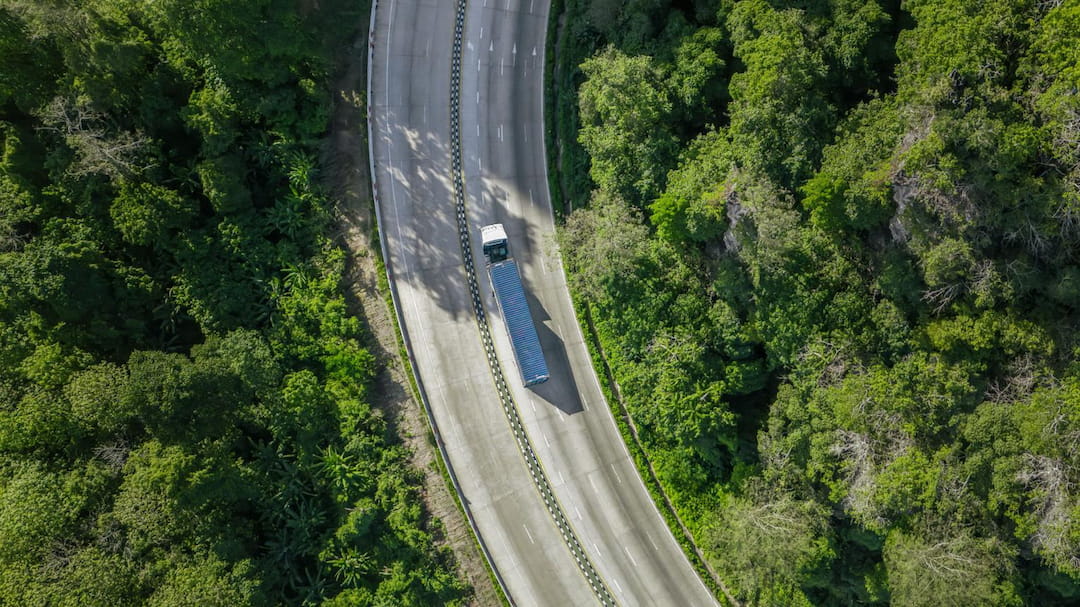
A single way of measuring the greenhouse gases that lorries, trains, ships and planes pump into the air has finally landed in EU law. The CountEmissionsEU regulation entered into force on 1 June, ending years in which a tonne of carbon shipped from Rotterdam to Milan could be tallied a dozen different ways depending on which calculator a company happened to use.

The premise is deceptively simple. Until now, two firms quoting the emissions of the same delivery could publish wildly different figures, neither of them wrong under any binding rule because no binding rule existed. Shippers comparing carriers were effectively comparing marketing claims. CountEmissionsEU replaces that free-for-all with one methodology, anchored to the international standard EN ISO 14083, so that a published number means the same thing whoever produced it.

Crucially, the rules cover door-to-door journeys rather than isolated legs. A parcel that travels by van to a railhead, crosses a border by freight train and finishes on a delivery bike will carry an emissions figure for the whole chain, not just the part a single operator controls. That matters because the messy interchanges between modes are exactly where carbon accounting used to disappear, and where customers had no way of telling an efficient route from a wasteful one.

The Commission has been careful to frame this as a transparency instrument rather than a new tax or cap. Companies are not forced to disclose their transport emissions; the regulation governs how they do it once they choose to. The bet is that comparability creates its own pressure. If a logistics buyer can line up three quotes with credible, like-for-like carbon numbers, the cleaner option stops being an act of faith and becomes a line on a spreadsheet.

Smaller operators, who feared drowning in audit paperwork, won an important concession. SMEs are exempt from the verification requirement for the data they generate, unless they actively seek proof of compliance to win contracts that demand it. To soften the learning curve further, the Commission has promised a free calculation tool and accompanying manual, aimed squarely at firms without a sustainability department to lean on.

None of this bites overnight. Full application is pencilled in for the end of 2030, giving industry, software vendors and national administrations several years to wire the standard into booking platforms, freight exchanges and procurement systems. Sceptics will note that a voluntary disclosure regime with a four-and-a-half-year runway is a long way from forcing anyone to cut a single gramme of carbon, and they are right that the regulation does not mandate reductions.

The counterargument is that measurement is the precondition for everything else. Europe has set itself binding climate targets that the transport sector, almost alone, keeps missing. You cannot manage what you cannot compare, and for two decades the bloc could not compare. Whether CountEmissionsEU nudges real behaviour or simply produces tidier reports will depend on how aggressively buyers, regulators and investors decide to use the new numbers. The plumbing, at least, is now in place.