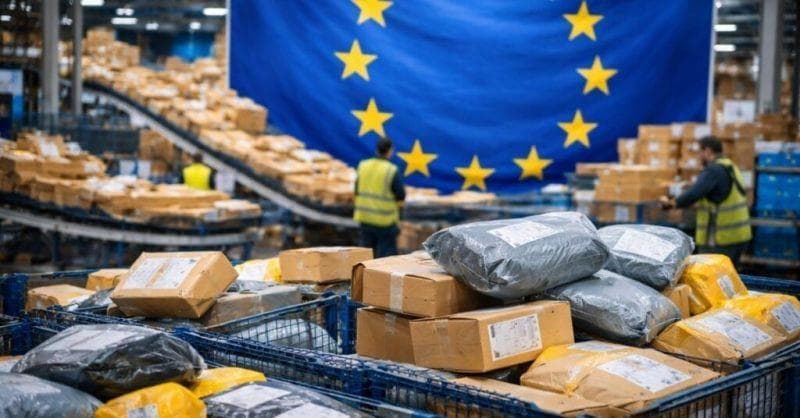
Brussels: The bargain that built a billion-package habit is about to get more expensive. From 1 July 2026 the European Union scraps the exemption that has long spared imported parcels worth 150 euros or less from any customs duty, replacing it with a flat charge of three euros on each low-value item shipped from a business outside the bloc to a consumer inside it. The change ends a loophole that customs officers had watched balloon as e-commerce platforms flooded the single market with billions of small consignments, many of them undervalued on the paperwork to slip beneath the threshold.
The parcel rule is only the most visible piece of a far larger overhaul. In late March the Council and the European Parliament reached provisional agreement on the most ambitious rewrite of EU customs rules since the union was founded in 1968, and at its heart sits a new institution. The European Union Customs Authority will be based here in the north of France, staffed by roughly 285 officials, and charged with knitting together the fragmented work of twenty-seven national administrations that have until now applied common rules in stubbornly uncommon ways.
The authority will not replace national customs services at the border. Instead it will build and run EU-level risk analysis, pooling data so that a shipment flagged as suspect in one port cannot simply be rerouted to a more permissive one. It will issue periodic recommendations meant to push member states toward a uniform reading of the rulebook, and it will sit atop a planned data hub designed to give officers a single, real-time picture of goods entering the union rather than the patchwork of national IT systems they navigate today.
For traders the transition will be uneven. Large logistics operators that already file electronically may absorb the new architecture with little friction, while smaller importers and the platforms that depend on high-volume, low-value flows face fresh compliance costs and the prospect that the undervaluation games of the past decade no longer pay. Consumer groups have warned that the three-euro charge, modest in isolation, will accumulate quickly for households accustomed to ordering cheaply from abroad.
The political bargain still needs formal sign-off from both institutions before the wider reform takes effect, and the data hub will be phased in over years rather than switched on at once. But the July parcel deadline lands first, and it offers an early test of whether the union can collect what it is owed without grinding cross-border trade to a halt. Officials in the new Lille headquarters will spend the rest of the year proving the machinery can scale before the harder structural changes arrive.