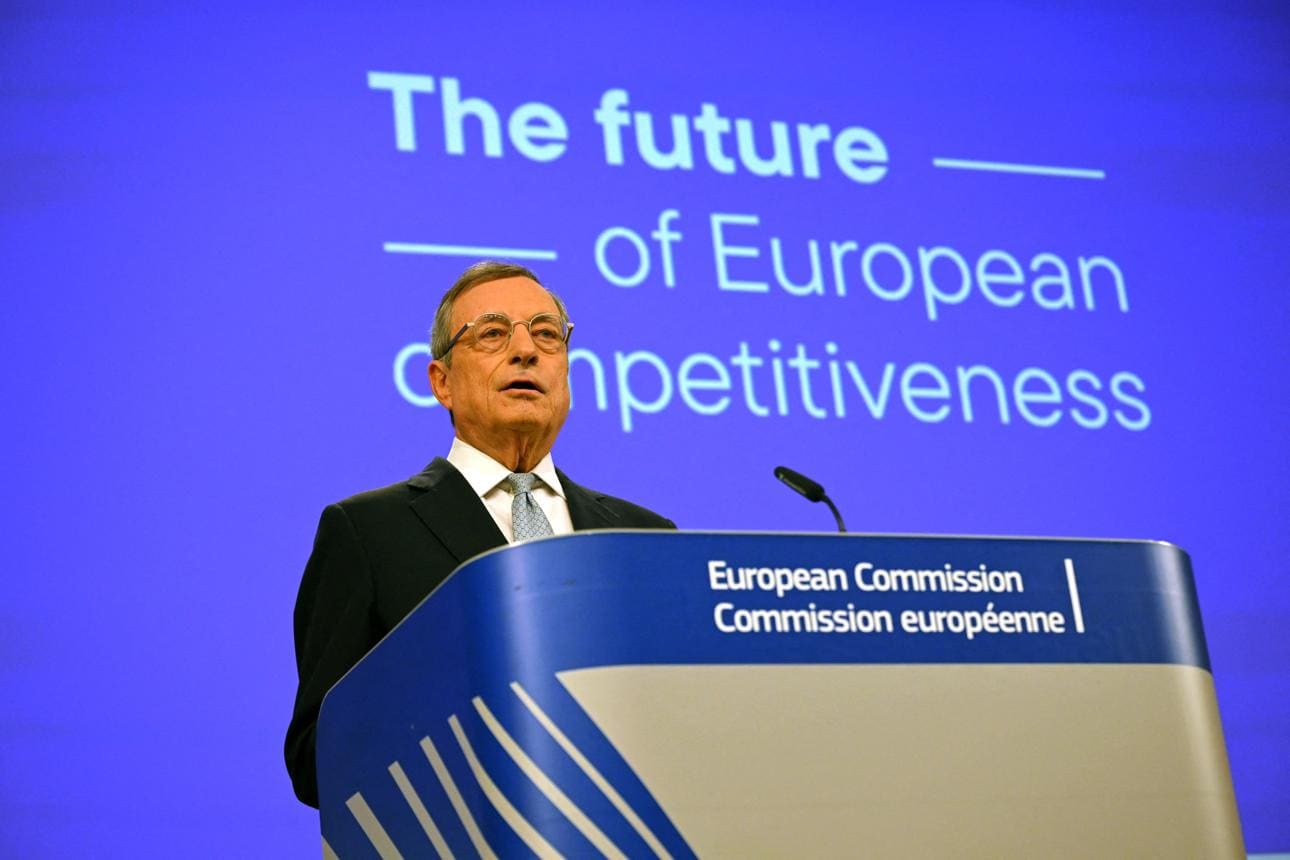
Frankfurt: Nearly two years after Mario Draghi handed Brussels a sweeping diagnosis of Europe’s economic decline, the prescription still gathers dust on too many shelves. The former central banker’s report set out 383 reform proposals, yet by his own reckoning the Union has fully delivered only around a tenth of them.
The document landed with force because Draghi named the stakes plainly. Europe, he argued, has fallen behind the United States and China on productivity, innovation and scale, and it must invest roughly 800 billion euros a year, some 4 to 5 percent of output, simply to hold its ground. That figure still frames every debate about the bloc’s future.
The Commission answered in early 2025 with a Competitiveness Compass, a roadmap that borrowed Draghi’s language and promised to cut red tape, deepen capital markets and speed innovation in clean tech, artificial intelligence and defence. The competitiveness agenda has since become the reference point for the mandate.
Momentum, though, keeps snagging on national politics. Diplomats describe an agenda partly blocked by capitals wary of ceding control over spending, industrial policy and financial regulation. Draghi called for joint borrowing and a genuine capital markets union, yet member states balk at the loss of sovereignty each idea implies.
Frankfurt watches with particular interest. As the seat of the European Central Bank, the city knows how far a unified financial system remains from reality, with savings still trapped in fragmented national markets and firms starved of the deep pools of risk capital that American rivals enjoy. A working capital markets union would change that calculus.
Backers of the plan warn against defeatism. They point to concrete launches, from simplification packages to a push on the so-called 28th regime that would let companies operate under one voluntary set of EU rules. Reform on this scale, they argue, always moves in fits and starts rather than in a single leap.
Sceptics see a deeper problem than pace. The money Draghi demands has no obvious source, since member states resist common debt and national budgets already strain under defence and welfare bills. Without financing, they contend, the boldest proposals stay theoretical.
The geopolitical backdrop adds urgency. Trade tensions, tariff threats and a scramble for critical technologies leave Europe exposed, and each month of delay widens the gap with faster-moving rivals. Draghi himself has grown blunt, warning that the cost of inaction now outstrips the cost of reform.
For the coming year, the test of Europe’s competitiveness agenda is no longer whether leaders admire the diagnosis. They plainly do. The test is whether they will spend the money and surrender the control that the cure requires, and Frankfurt, like every financial centre on the continent, is still waiting for the answer.