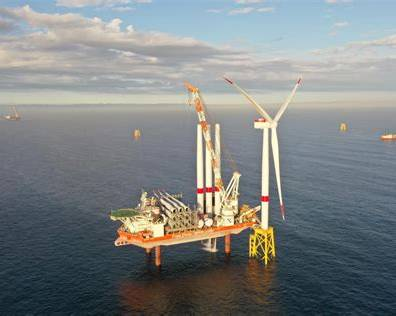
Esbjerg: From the quaysides of Denmark’s busiest wind port, where turbine blades the length of football pitches wait to be shipped out to sea, the direction of Europe’s power system has rarely looked clearer. Offshore wind generation across the European Union climbed to a record 14.6 terawatt hours in the first half of 2026, up from 11.4 terawatt hours a year earlier, as a wave of new capacity finally came online.
The offshore surge builds on a milestone reached the previous year, when wind and solar together supplied 30 percent of the bloc’s electricity and edged past fossil fuels, which fell to 29 percent. Coal, once the backbone of European power, has continued its retreat, squeezed by carbon costs, cheaper renewables and ageing plants that owners are reluctant to refurbish.
Policy is pushing in the same direction. Under rules that took effect this year, member states must apply non-price criteria to at least 30 percent of the volume they auction for renewables each year, or to at least six gigawatts, whichever is smaller. The shift means bids are no longer judged on cost alone. Governments can now reward projects that strengthen European supply chains, cyber resilience and responsible sourcing, a response to fears that the continent had grown too dependent on imported components.
For a port like Esbjerg, the numbers translate into steel, jobs and crowded logistics yards. Yet the industry’s mood is not uniformly buoyant. Developers have spent the past two years wrestling with higher financing costs, stretched grid connections and supply bottlenecks that delayed several flagship projects. A record half-year of generation reflects investment decisions taken long ago, and the pipeline for the end of the decade looks thinner than the Commission’s targets demand.
Grid capacity is the tightest constraint. Turbines can spin, but without new cables and substations their power cannot always reach the cities that need it, and operators increasingly pay to switch farms off when networks clog. Officials acknowledge that the pace of grid investment must accelerate sharply if the renewable share is to keep climbing rather than plateau.
Critics of the headline figures caution against complacency. Wind and solar remain weather-dependent, and a still, cloudy stretch can send gas plants roaring back to cover the gap. The bloc’s decarbonisation, they argue, will stand or fall on storage, flexible demand and interconnection rather than raw generation records. Supporters reply that momentum matters, and that each record makes the fossil-heavy alternative harder to justify. Details of the EU’s wider push sit within its wind energy strategy, but on the Esbjerg waterfront the trend already feels settled: the sea is doing more of Europe’s heavy lifting.